Niche Dong Village · Guizhou
Zhaoxing Dong Village
Zhaoxing is a Dong village in Liping County, Guizhou, known for five clan drum towers, covered wind-and-rain bridges and the Grand Song of the Dong ethnic group. Travel sources often call it the largest Dong village — that is their description, not our claim. Go to hear the singing live, walk the towers and bridges, and understand how it differs from the more commercialised Xijiang Miao Village.
Affiliate link · we may earn a commission · tracking URL to be replaced
Before You Go
Why choose Zhaoxing over Xijiang?
Both are headline ethnic villages in Guizhou, but they answer different trips. Search results compare them directly: Zhaoxing is Dong, quieter and moderately commercialised, with five drum towers and the Grand Song; Xijiang is Miao, known for a vast stilt-house settlement, night views and heavier visitor numbers. Choose Zhaoxing if the music, timber architecture and a slower village matter more than a large night scene.
Good fit
- The Grand Song of the Dong ethnic group, heard in performance rather than read about
- Five clan drum towers and covered wind-and-rain bridges in one walkable village
- Dong timber architecture and living craft traditions
- A quieter village base in Liping County, Guizhou
- A direct comparison with Xijiang before you commit to one
Consider elsewhere
- A Miao stilt-house settlement and night skyline — that is Xijiang, a different village and people
- A five-star scenic area — Zhaoxing itself is not a 5A site (Chengyang Eight Villages in Guangxi is, and is a separate place)
- A nightlife and shopping hub — Zhaoxing is moderately commercialised, not a party destination
- Visitors wanting live ticket or hotel prices — we do not hold them here
Zhaoxing sits in Liping County in the Qiandongnan Miao and Dong Autonomous Prefecture of Guizhou. Travel sources date the settlement to around the Southern Song dynasty and often describe it as the largest Dong village — a description we attribute to those sources rather than assert ourselves. What makes it legible to a visitor is its layout: five drum towers, each associated with a clan and named after a Confucian virtue, stand among timber houses, with wind-and-rain bridges crossing the streams.
The reason to come is not the label but the Grand Song of the Dong ethnic group. It entered China's national intangible cultural heritage register in the first batch in 2006 and was inscribed on UNESCO's Representative List in 2009. It is a polyphonic tradition sung without score, instruments or conductor. Hearing it in the village — in a performance space rather than a clip — is the experience that a page like this can point toward.
The search results for Zhaoxing are already answered at the top: what it is, where it is, when it was founded, what a drum tower is. So this guide deals with the questions that remain. Why pick Zhaoxing rather than Xijiang, what the five towers and bridges actually are, where the singing happens, and how the Dong timber craft fits into a wider Guizhou route.
What You See
A site you can read in layers
The wall, the bank, the temple sculpture and the lacquer workshop — each adds a period of the story. This is what a day here is made of.
More reading routes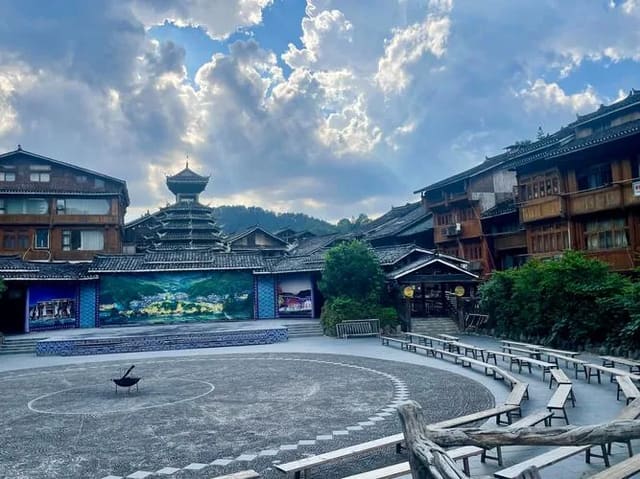
-
01 · The decision
Zhaoxing or Xijiang?
Start here if you are choosing between Guizhou's two best-known ethnic villages. Zhaoxing is a Dong village with five drum towers, wind-and-rain bridges and the Grand Song; Xijiang is a Miao settlement known for thousands of stilt houses, night views and larger crowds. Both are valid trips — the table below sets out the difference so you do not book the wrong one.
-
02 · The landmark
The five drum towers
The five drum towers are the defining sight of Zhaoxing. Travel guides link them to five clans and to Confucian virtues, and describe the structures as timber built without nails. This is a long-tail search in its own right with no AI Overview at the time of research, so it is worth walking the towers in person and reading the details rather than relying on a summary.
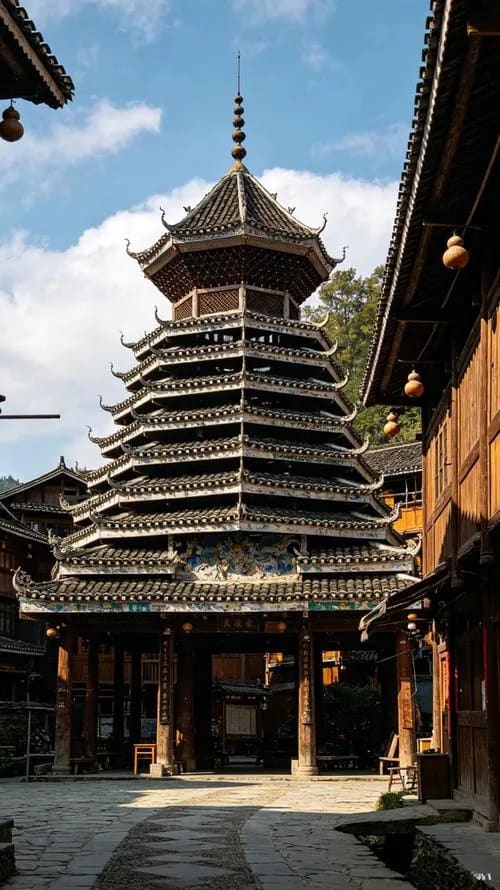
The five drum towers of Zhaoxing — the village's defining landmark. -
03 · The bridges
Wind-and-rain bridges
Covered wind-and-rain bridges cross the streams through the village and double as gathering spaces, not just crossings. Together with the drum towers they form the timber architecture that search results associate with Zhaoxing. Walk them slowly — the social use of the bridge is as much the point as the structure.
-
04 · The singing
A Grand Song performance
The Grand Song of the Dong ethnic group is on China's national intangible heritage register from 2006 and on UNESCO's Representative List from 2009. It is unaccompanied polyphony without a written score or conductor. A performance venue in the village is where visitors can actually hear it — check current performance arrangements locally before you go.
Registry-backed fact
-
05 · The craft
Dong timber building and weaving
Dong timber architecture is itself intangible heritage in the national register, recorded for Liping County in the second batch in 2008. Weaving and indigo dyeing are part of the living craft context of a Dong village. Note that the craft spans counties and provinces — the Chengyang Yongji Bridge in Guangxi, for example, is a separate site associated with a named inheritor, not part of Zhaoxing.
Registry-backed fact
-
06 · The route
Getting to Zhaoxing
Zhaoxing is in Liping County, Guizhou, in the Qiandongnan prefecture. Most visitors reach it via Guizhou transport hubs such as Kaili or Guiyang, then continue by road or rail; arrangements change, so check current services before you plan. Allow a night if you want to hear the village after day visitors leave.
If the wall and the craft interest you
See the guided ways to visit
Walks and temple visits are the two options people most often compare here. Check current availability and cancellation terms on the provider page before you book.
See Guizhou & Kaili toursAffiliate link · we may earn a commission · tracking URL to be replaced
The Source
What the sources actually say
Village and register facts below come from the Ministry of Culture tourism snapshot and the national intangible heritage register; the UNESCO year is confirmed by official English-language sources. The "largest Dong village" phrase is a travel-source description, not a superlative we assert.
- 2009
- Year the Grand Song entered the UNESCO Representative List
- 2006
- Year the Grand Song entered China's national ICH register, first batch, Liping County
- 5
- Clan drum towers that define the village, per travel sources
- 2nd batch
- National rural tourism key village status for Zhaoxing Village, per the Ministry of Culture snapshot
Source: China ICH project register / Ministry of Culture tourism snapshot / UNESCO ICH / China.org.cn & China Daily. ICH and tourism snapshots, 25 November 2026; UNESCO year confirmed via China.org.cn / China Daily..
Zhaoxing or Xijiang? And what are you coming to see?
Search results compare these two villages directly and mix the Grand Song (intangible heritage) with timber architecture (a different heritage entry). These tables separate them so you can plan the right trip.
| Zhaoxing Dong Village | Xijiang Miao Village | |
|---|---|---|
| People | Dong ethnic group | Miao ethnic group |
| Signature sight | Five clan drum towers and wind-and-rain bridges | A large hillside of Miao stilt houses |
| Music and culture | Grand Song of the Dong, UNESCO ICH 2009 | Miao song, dance and festivals |
| Atmosphere | Quieter, moderately commercialised | Larger crowds, known for night views |
| Location | Liping County, Qiandongnan, Guizhou | Leishan County, Qiandongnan, Guizhou |
Common Questions
Is Zhaoxing worth visiting?
If you want to hear the Grand Song live, walk five drum towers and covered bridges, and see a Dong village that is quieter than Xijiang, yes. A night is enough to feel it after the day visitors leave. If you want a Miao stilt-house skyline and nightlife, Xijiang is the different trip you are looking for.
What is the most beautiful village in China?
There is no single answer — this is a recurring travel question rather than an official title. Zhaoxing often appears in such lists for its Dong drum towers, bridges and Grand Song. Treat those lists as editorial opinion and choose for the culture you actually want to see.
How many days in Guizhou is enough?
It depends on how much of the province you want to cover. For Zhaoxing alone, one night in the village plus travel time is enough for the towers, bridges and a performance. Add days if you also want Xijiang, the provincial capital Guiyang, or other parts of Qiandongnan — transport between sites takes time.
What is the difference between Zhaoxing and Xijiang?
Zhaoxing is a Dong village in Liping County, known for five drum towers, wind-and-rain bridges and the Grand Song, and is generally quieter and moderately commercialised. Xijiang is a Miao village in Leishan County, known for a large stilt-house settlement and night views, with heavier visitor numbers. Both are in Qiandongnan, Guizhou, but they are different places and cultures.
What is the Grand Song of the Dong ethnic group?
It is a form of unaccompanied polyphonic singing without a written score, instruments or conductor, traditionally performed by Dong communities. It entered China's national intangible cultural heritage register in 2006 (first batch, Liping County) and was inscribed on UNESCO's Representative List in 2009. You can read more on our Dong Grand Song page.
How do I get to Zhaoxing?
Zhaoxing is in Liping County, Qiandongnan, Guizhou. Visitors commonly route through Guizhou hubs such as Kaili or Guiyang and continue by road or rail. Services change, so check current connections before you plan. Staying overnight lets you experience the village after the day crowds leave.
Plan Your Visit
Tours and experiences
Compare guided options in one place. Prices and availability are set by each provider and are not maintained on this page.
As an affiliate, we may earn a commission from qualifying purchases. Prices and availability are set by the provider and are not maintained on this page.
Sources and data note
Facts: China ICH project register (Grand Song Ⅱ-028_01_522631, 2006 first batch, Liping County; Dong timber architecture Ⅷ-030_02_522631, 2008 second batch, Liping County); UNESCO ICH Representative List (Grand Song, 2009, confirmed via China.org.cn / China Daily official English sources); Ministry of Culture tourism snapshot (Zhaoxing Village, Liping County, second batch national rural tourism key village; Chengyang Eight Villages scenic area, Guangxi, 5A in 2024 — a separate site); inheritor register (Yang Siyu, Dong timber architecture, first batch 2007, Guangxi Sanjiang, builder of Chengyang Yongji Bridge — mentioned as context, not given a separate page). Drum-tower and bridge descriptions follow the independent Google SERP and are attributed to travel sources rather than asserted as superlatives. "Largest Dong village" is a travel-source description, deliberately not repeated as our claim. Affiliate links are category-level deep links, not live prices; replace with your own tracking URLs before launch.
Another wall, another tradition
More niche heritage sites
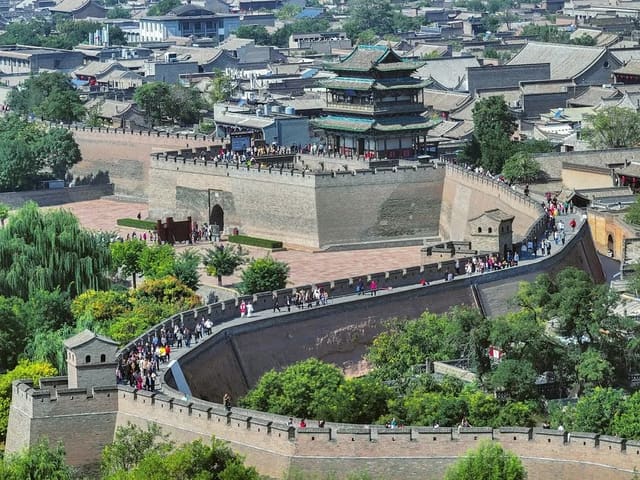 Pingyao Ancient City Niche Heritage Site · Shanxi
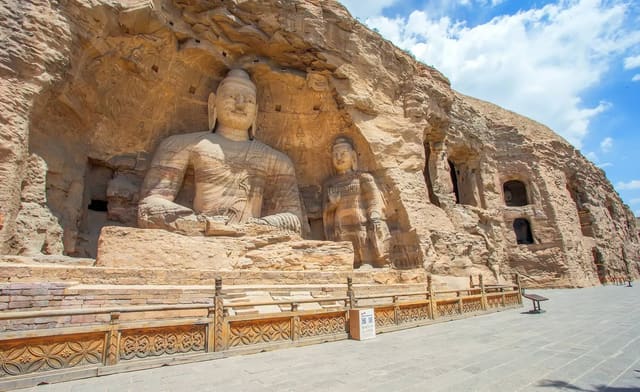 Yungang Grottoes Niche Heritage Site · Shanxi
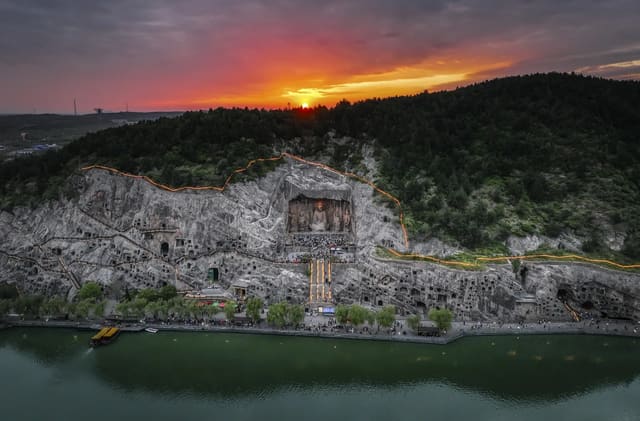 Longmen Grottoes Niche Heritage Site · Henan
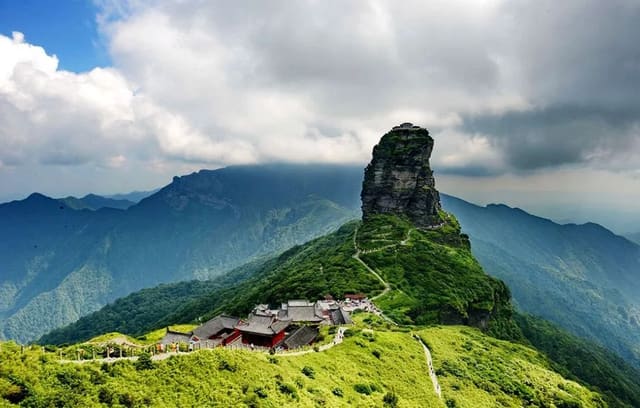 Fanjingshan Temples Niche Heritage Site · Guizhou
 Maijishan Grottoes Niche Heritage Site · Gansu
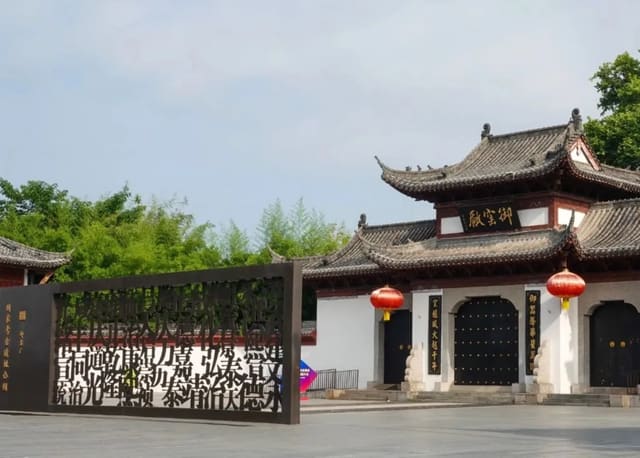 Jingdezhen Porcelain Capital Niche Heritage Site · Jiangxi
 Wudang Mountains Niche Heritage Site · Hubei
 Shaxi Ancient Town Niche Heritage Town · Yunnan
 Harbin Winter City · Heilongjiang