A coastal province with rich folk traditions including Yangge dance, kite making, Chinese chess culture, and Confucian heritage.
As a vital node in China's cultural geography, this location has nurtured artistic traditions
that have endured through dynastic changes, social transformations, and the challenges of modernity.
The continuity of these practices speaks to the deep relationship between place and cultural identity.
Today, Shandong Province continues to be a living center of heritage — where master artisans
train the next generation, festivals mark the seasons, and ancient crafts adapt to contemporary life.
auto_awesome
travel_explore
Civilization Snapshot
travel_explore
Coordinates36.343°N, 118.650°E
map
Cultural Zonenorth-china
density_small
Heritage Density
4 traditions registered
Through the Eras
Pre-ImperialBefore 221 BCE
Imperial Era221 BCE – 1912 CE
Modern Era1912–Present
mapLandscape of Practice
Where heritage lives — the geography of cultural practice
Interact with the nodes of cultural heritage across the region's ancient grid.
The heritage of Shandong Province does not exist in isolation. It is the core of a sophisticated network
of exchange, where techniques, motifs, and melodies traveled to shape the identity of an entire civilization.
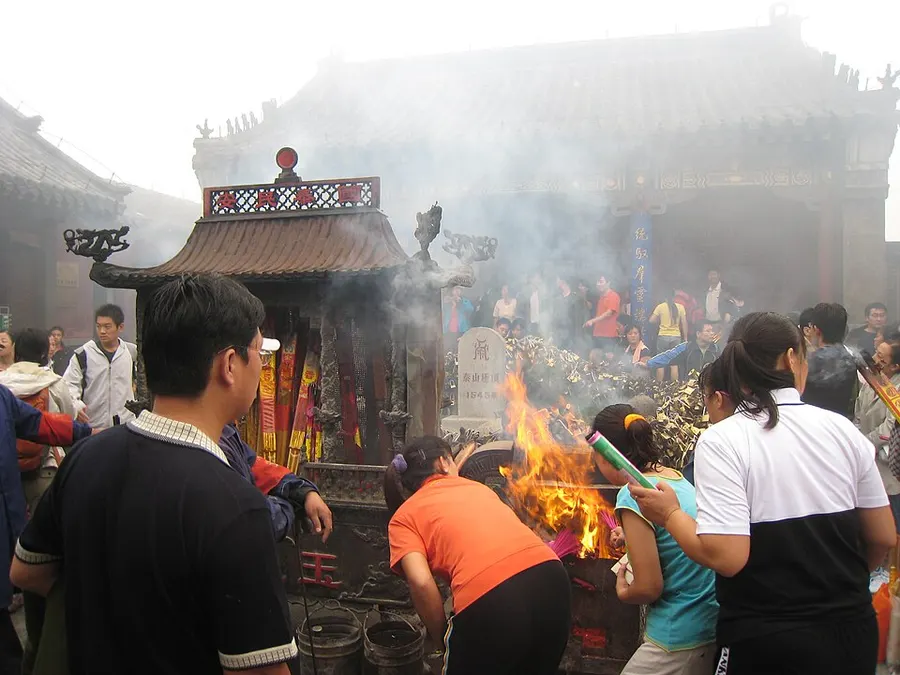
Shandong carries the state of Lu's legacy as Confucius's homeland. The temple, mansion, and cemetery of the Kong family at Qufu — expanded across two millennia — joined UNESCO in 1994, and Mount Tai south of Jinan had already become China's first mixed natural-and-cultural World Heritage site in 1987 after serving as the empire's foremost sacrifice peak.
Sport history adds a twist. FIFA certified Linzi, ancient Qi's capital in the province, as football's birthplace in 2004, citing cuju match accounts from the Warring States era; bronze figurines there show players kicking a feather-stuffed ball two millennia before modern rules.
handyman
Cultural Traditions
01
Memorial Rites
Qufu's grand Confucius ceremony each 28 September draws state delegations.
02
Mount Tai Climbs
Six thousand steps pass imperial inscriptions to the sunrise platform.
A young cowherd named Niulang discovers the heavenly weaver girl Zhinu bathing in a river. They fall in love and marry, but Zhinu's mother, the Queen Mother of Heaven, separates them with the Milky Way. Once a year, on the seventh night of the seventh month, magpies form a bridge across the stars so they can reunite — this is the origin of Qixi Festival.