Traditional Music
Shandong Province, East China
Warring States period (5th–3rd century BCE)
National Heritage
Master-Apprentice (Oral/Aural)
Guzheng Playing
Guzheng (Chinese Zither)
"A 21-string plucked zither beloved across China — from ancient court music to modern concert halls."
CIVILIZATION CONTEXT
This artifact is part of the Intangible Heritage Cluster. It connects to 9 entities across the atlas, spanning 2 regions, 0 masters, 0 festivals, and 1 skill.
Guzheng (Chinese Zither): A Living Heritage
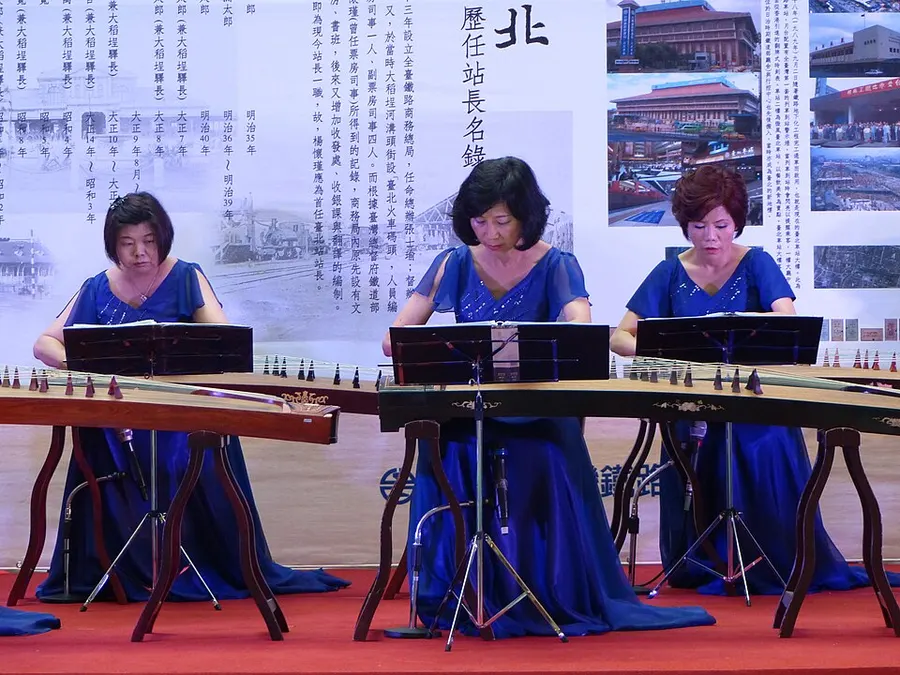
The guzheng is a Chinese plucked zither with 21 strings that has been played for over 2,500 years. Originally a five-string instrument from the Warring States period, it evolved into a versatile instrument capable of both delicate melodies and powerful percussive passages. Modern guzheng music spans traditional folk tunes, classical compositions, and contemporary works. It is one of the most popular traditional instruments in China today.
Centuries
Years of Unbroken Lineage
1
Related Cultural Vectors
History & Development
The guzheng took shape in the Qin state during the Warring States period and grew from thirteen Tang-dynasty strings to the modern standard of twenty-one, each resting on a movable bridge. Tang players carried the instrument eastward, where its descendant became Japan's koto, and Chinese opera houses and teahouses made the zheng a fixture of popular entertainment.
Regional schools in Shandong, Henan, Chaozhou, Hakka country, and Jiangsu-Zhejiang developed distinct tunings and ornament, and Lou Shuhua's 1930s classic Fishing Boat Song at Dusk became the most-taught solo piece. The State Council listed guzheng art in the national intangible heritage list in June 2008, and conservatory grading now enrols millions of students.
How It Is Made
- 01
Tuning the pentatonic scale
Players slide the movable bridges to set a five-note scale per octave, retuning between pieces to match each regional school's mode.
- 02
Bending pitches with the left hand
Pressing strings left of the bridges raises notes a semitone or more, producing the slides and vibrato that make the zheng sing.
- 03
Sweeping glissandos
The right hand plucks with picks taped to four fingers, running rapid arpeggios and full-scale sweeps that imitate water and wind.
- 04
Studying school repertoire
Each region guards signature pieces, so advanced students compare Chaozhou ornament against Shandong drive before settling a specialisation.
Common Questions
How is the guzheng different from the guqin?
The zheng carries many bridged strings for bright glissandos and quick retuning, while the seven-string, bridgeless guqin favours quiet sustained tones, a contrast explored in the guzheng sound story.
Why movable bridges?
Bridges let one instrument serve every regional mode; moving a support retunes a string instantly, which fixed-fret instruments cannot do.
Which pieces should newcomers hear?
Fishing Boat Song at Dusk, High Mountains and Flowing Water, and the Chaozhou school's ornamented suites form the classic starting set heard in teahouse ensembles alongside Nanyin chamber music.
Watch & Learn
Stories & Legends
The Sound of Silk: Guzheng Across Millennia
historicalWhen the guzheng player's fingers sweep across 21 strings, Chinese memory speaks.
The Lute That Crossed the Desert: Pipa
historicalA Persian instrument that crossed the Silk Road and became unmistakably Chinese.
Skills & Techniques
Guzheng Playing expand_more
The technique of playing the 21-string Chinese zither using finger picks for plucking, pressing, and glissando effects.
Steps
- Tune the 21 strings using tuning pegs
- Wear ivory or plastic finger picks on right-hand thumb, index, and middle fingers
- Practice basic plucking techniques: tuō (outward), mǒ (inward), and gōu (hook)
- Learn left-hand pressing techniques on strings to create pitch bends and vibrato
- Master glissando (playing multiple strings in sequence) and chord plucking
- Combine techniques to perform traditional and contemporary repertoire
Tools
guzheng instrument, tuning key, finger picks (ivory or plastic), tuning fork
Materials
guzheng strings (silk or steel-nylon)
Related Places
Relationship Constellation
Tracing the invisible threads that connect Guzheng (Chinese Zither) to the broader civilization ecosystem.
Continue the Journey
Guzheng (Chinese Zither)
Traditional Music
Erhu (Chinese Two-String Fiddle)
Traditional Music
arrow_forwardPipa (Chinese Lute)
Traditional Music
arrow_forwardTraditional Li Textile Techniques
Traditional Crafts
arrow_forward