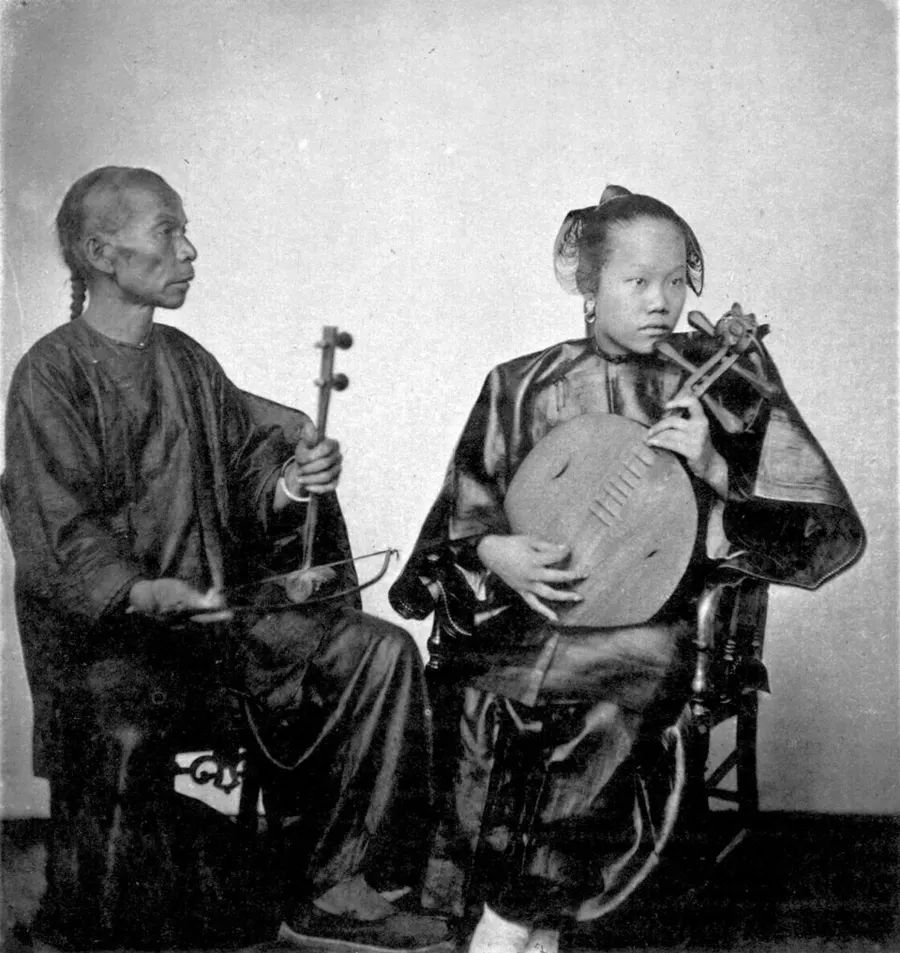
Traditional Music
Beijing, North China
Tang Dynasty (618–907 CE), evolved from Central Asian xiqin
National Heritage
Master-Apprentice (Oral/Aural)
Erhu Playing
Erhu (Chinese Two-String Fiddle)
"China's most expressive bowed instrument — a two-stringed fiddle capable of heart-wrenching melodies and virtuosic technique."
CIVILIZATION CONTEXT
This artifact is part of the Intangible Heritage Cluster. It connects to 6 entities across the atlas, spanning 1 region, 0 masters, 0 festivals, and 1 skill.
Erhu (Chinese Two-String Fiddle): A Living Heritage
The erhu is a two-stringed bowed instrument, often called the Chinese violin. Originating from Central Asian instruments brought to China over 1,000 years ago, it evolved into a uniquely expressive solo instrument. The erhu's sound is produced by a bow passing between the two strings, allowing for subtle pitch bends and vocal-like expressiveness. Famous pieces like "The Moon Reflected in Erquan Spring" showcase its emotional depth.
1119+
Years of Unbroken Lineage
1
Related Cultural Vectors
History & Development
The erhu descends from the xiqin, a two-string bowed fiddle documented in Tang-dynasty sources among northern peoples, and by Song times bowed strings sat inside opera and narrative-song bands across China. Its modern identity came late: in the 1920s composer Liu Tianhua wrote ten etudes for the instrument, fixed its two-string tuning, and carried it into conservatory classrooms as a serious solo voice.
Blind street musician Abing recorded his Moon Reflected on Second Spring in 1950, just months before his death, and that single tape made the erhu's singing melancholy famous worldwide. Today conservatories grade students through ten examination levels, and manufacturers standardised steel strings and balanced python-skin resonators for orchestral sections.
How It Is Made
- 01
Stretching the resonator skin
Makers soak python skin, stretch it taut across the hexagonal sound box, and bind it until dry so the membrane vibrates freely at playing tension.
- 02
Setting the strings and qian jin
Two strings tune a fifth apart, and the looped cord called qian jin fixes their vibrating length high on the narrow neck, shaping the instrument's nasal sweetness.
- 03
Bowing between the strings
Unlike Western bows, erhu bow hair runs permanently between the two strings; players tilt the wrist to weight either string without ever lifting the bow away.
- 04
Voicing with fingers alone
With no fingerboard or frets, fingertips stop the strings in mid-air, rolling for vibrato and sliding between positions to imitate speech inflections.
Common Questions
Why does the erhu sound so human?
Continuous pitch control from the finger-free neck plus breath-like bowing lets players bend tones the way singers slide between notes, which is why film scores assign it weeping or longing melodies.
How is it different from a violin?
The violin's fingerboard and detached bow give crisp articulation, while the erhu's membrane resonator, trapped bow, and bare-string stopping trade attack for vocal portamento.
Where does the erhu sit in Chinese music?
It leads folk ensembles and film soundtracks alike, sharing repertoire stages with plucked strings such as the pipa lute and appearing in the exam curricula that also cover the guzheng zither.
Watch & Learn
Stories & Legends
The Sound of Silk: Guzheng Across Millennia
historicalWhen the guzheng player's fingers sweep across 21 strings, Chinese memory speaks.
Skills & Techniques
Erhu Playing expand_more
The art of playing the two-stringed Chinese fiddle, known for its expressive, vocal-like sound produced by a bow passing between the strings.
Steps
- Tune the two strings to a fifth interval (D–A or G–D)
- Rosin the horsehair bow
- Position the bow between the two strings
- Practice long tones to develop steady bow control
- Learn left-hand techniques: vibrato, glissando, and hua yin (sliding tones)
- Master bowing techniques: detache, spiccato, and rapid tremolo
Tools
erhu instrument, erhu bow, rosin, tuning pegs, bridge, tuning fork
Materials
erhu strings (steel inner, steel-nylon outer), snake skin (python) for the soundbox
Related Places
Relationship Constellation
Tracing the invisible threads that connect Erhu (Chinese Two-String Fiddle) to the broader civilization ecosystem.
Continue the Journey
Erhu (Chinese Two-String Fiddle)
Traditional Music
Pipa (Chinese Lute)
Traditional Music
arrow_forwardDizi (Chinese Bamboo Flute)
Traditional Music
arrow_forwardGuzheng (Chinese Zither)
Traditional Music
arrow_forward