The Lute That Crossed the Desert: Pipa
historicalA Persian instrument that crossed the Silk Road and became unmistakably Chinese.
Xinjiang Uyghur Autonomous Region
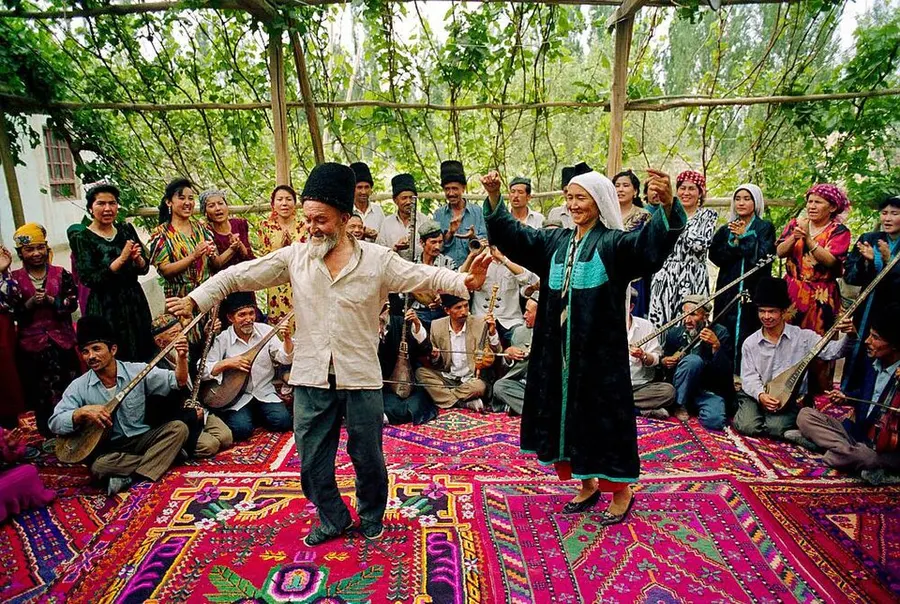
China's largest province, home to the Uyghur people and diverse Central Asian cultures. The heartland of Uyghur Muqam music, Meshrep gatherings, and Manas epic tradition.
As a vital node in China's cultural geography, this location has nurtured artistic traditions that have endured through dynastic changes, social transformations, and the challenges of modernity. The continuity of these practices speaks to the deep relationship between place and cultural identity.
Today, Xinjiang Uyghur Autonomous Region continues to be a living center of heritage — where master artisans train the next generation, festivals mark the seasons, and ancient crafts adapt to contemporary life.
Interact with the nodes of cultural heritage across the region's ancient grid.
The cultural heart of Xinjiang Uyghur Autonomous Region
Traditional workshops and living heritage
The heritage collection of Xinjiang Uyghur Autonomous Region
A Lineage of Eras
“The craft is not just technique — it is the memory of our ancestors speaking through our hands.”
READ THEIR STORYThe heritage of Xinjiang Uyghur Autonomous Region does not exist in isolation. It is the core of a sophisticated network of exchange, where techniques, motifs, and melodies traveled to shape the identity of an entire civilization.
2 seasonal observances
2 seasonal observances
2 seasonal observances
2 seasonal observances
Nearby heritage destinations
北京 · The capital of China, Beijing has been the political and cul...
南京 · An ancient capital of six dynasties, Nanjing is the birthpla...
苏州 · Famous for its classical gardens and silk industry, Suzhou i...
陈家沟 · A small village in Henan Province, Chenjiagou is the birthpl...
“Places Remember Through Practice — Xinjiang Uyghur Autonomous Region lives.”
Explore the MapXinjiang covers 1.66 million square kilometres, a sixth of China, and its oasis cities guarded every major branch of the Silk Road. The ruins of Jiaohe and Gaochang near Turpan anchor the 2014 Chang'an-Tianshan corridor World Heritage listing with thirty-three sites across two thousand kilometres.
Beneath the Taklamakan runs another marvel: roughly two thousand karez well galleries totalling some five thousand kilometres, an underground irrigation network ranked beside the Great Wall and Grand Canal. Uyghur musicians kept the Twelve Muqam alive through centuries of exchange until UNESCO listed it in 2005 as a masterpiece and moved it to the Representative List in 2008.
Singers, rawap players, and dancers perform suite cycles that can run a full day.
Village courts of music, wit, and moral teaching were inscribed by UNESCO in 2010 as meshrep.
Well keepers maintain vertical shafts that gravity-feed vineyards without pumps.
It is China's largest provincial-level region at 1.66 million square kilometres, bordering eight countries.
Twelve grand musical suites codified in the sixteenth century, UNESCO-listed and performed on rawap, tambourine, and voice.
Karez underground channels deliver snowmelt to Turpan's vineyards while sparing them surface heat.
Narratives from the atlas graph that share origins, practitioners, or settings with this topic.
A Persian instrument that crossed the Silk Road and became unmistakably Chinese.
Photographs documenting the materials, makers, and settings behind these traditions.