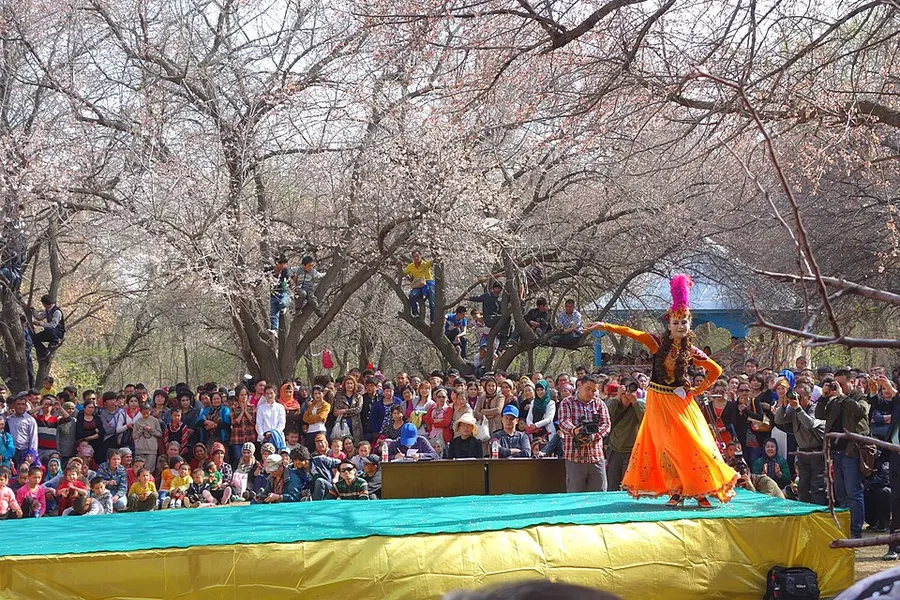
Traditional Dance
Xinjiang Uyghur Autonomous Region, Northwest China
Qing Dynasty (1644–1912 CE)
National Heritage
Master-Apprentice
Uyghur Sanam Dance Movements
Uyghur Sanam Dance
"A spirited Uyghur dance of expressive hands, shoulder movements, and quick footwork performed at weddings throughout Xinjiang."
CIVILIZATION CONTEXT
This artifact is part of the Intangible Heritage Cluster. It connects to 8 entities across the atlas, spanning 2 regions, 0 masters, 0 festivals, and 1 skill.
Uyghur Sanam Dance: A Living Heritage
Sanam is a lively Uyghur folk dance performed throughout Xinjiang, characterized by expressive hand and wrist movements, subtle shoulder shimmies, and quick footwork. Dancers move in a circle with controlled upper-body poise while the lower body executes rapid, intricate steps. Accompanied by dap (frame drum), dutar (lute), and rawap (string instrument), Sanam is performed at weddings and festive gatherings, with dancers alternating solo improvisations within the group circle.
114+
Years of Unbroken Lineage
1
Related Cultural Vectors
History & Development
Sanam is the Uyghur circle dance that carries the Twelve Muqam's pulse into the feet. The word names both a dance genre and the seventh of the twelve muqam suites, and in Kashgar courtyards and Hotan bazaars the dance begins the moment a muqam band's dap frame drum locks its 5/8 and 7/8 patterns. Dancers circle counter-clockwise, wrists circling, shoulders flicking, the body's isolations answering the drum's off-kilter accents; soloists break from the ring for spins and neck slides that the crowd applauds back into formation.
The form's survival was tied to the muqam's. Twentieth-century scholars led by Wan Tongshu transcribed the suites in the 1950s, and the 2005 UNESCO inscription of the Twelve Muqam of Xinjiang, followed by the 2008 listing of Uyghur meshrep gatherings where sanam thrives, anchored the dance's documentation. Sanam entered China's national inventory in 2008, and today it is the default celebration dance at Uyghur weddings, its circle opening to anyone who can hold the asymmetrical rhythm, tourists included, as long as they follow the dap.
How It Is Made
- 01
Reading the dap
The frame drum's low doom and high tak map the asymmetrical metres; dancers learn to hear the cycle before moving a wrist.
- 02
Circling the wrists
The signature gesture rolls each wrist in a small circle at chest height, arms tracing the melody's ornament.
- 03
Breaking for the solo
A dancer steps out for spins and shoulder isolations, holding the crowd's attention for exactly one phrase before rejoining the ring.
- 04
Closing with the dance song
The muqam's final dance section accelerates; the circle tightens, tempo doubles, and the last chord drops every dancer to a stop.
Common Questions
What does "sanam" mean?
It names both the circle dance and the seventh muqam suite; the music system is explained in our Twelve Muqam entry.
Where does it thrive?
Kashgar and Hotan gatherings, especially meshrep evenings, which have their own UNESCO listing and are covered in our meshrep entry.
Can visitors join the circle?
Yes; wedding and courtyard sanam welcomes newcomers who follow the dap's beat, and hosts will place a beginner behind an experienced dancer.
Watch & Learn
Stories & Legends
The Art of Silence: Peking Opera's Journey from Court to World
historicalIn a Peking Opera performance, every gesture tells a story.
Skills & Techniques
Uyghur Sanam Dance Movements expand_more
A lively Uyghur dance style characterized by expressive hand and wrist rotations, subtle shoulder movements, and rapid intricate footwork.
Steps
- Start in the basic Sanam stance — upright torso, arms slightly raised
- Perform wrist rotations (chombak) with fingers snapping in rhythm
- Execute shoulder shimmies while keeping the upper body elegantly poised
- Add quick footwork patterns — heel-toe steps and cross-steps
- Combine arm and foot movements in a traveling sequence around the circle
Tools
Uyghur embroidered cap (dopa), long braided hair ornaments, silk dress (khan atlas)
Materials
khan atlas silk, embroidery thread, silver jewelry
Relationship Constellation
Tracing the invisible threads that connect Uyghur Sanam Dance to the broader civilization ecosystem.
Continue the Journey
Uyghur Sanam Dance
Traditional Dance
Huangmei Opera
Traditional Drama
arrow_forwardHenan Opera (Yuju)
Traditional Drama
arrow_forwardYi Alili Dance (Axi Tiaoyue)
Traditional Dance
arrow_forward