Traditional Dance
Yunnan Province, Southwest China
Ancient Yi tradition
National Heritage
Master-Apprentice
Oral Tradition
Yi Alili Dance (Axi Tiaoyue)
"A Yi ethnic courtship dance performed under the full moon with springing steps, lively music, and colorful pleated skirts."
CIVILIZATION CONTEXT
This artifact is part of the Intangible Heritage Cluster. It connects to 7 entities across the atlas, spanning 2 regions, 0 masters, 0 festivals, and 0 skills.
Yi Alili Dance (Axi Tiaoyue): A Living Heritage
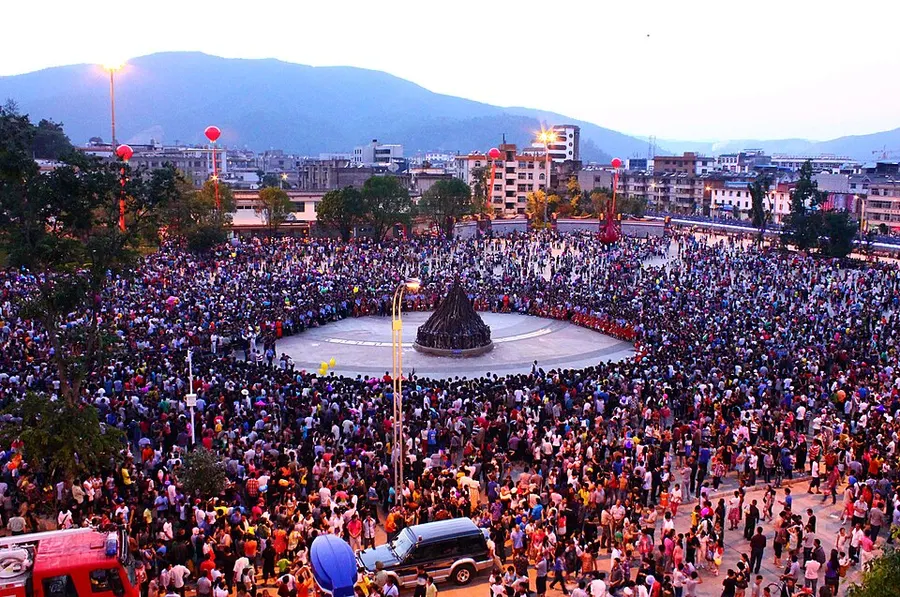
The Alili Dance, known as "Axi Tiaoyue" (Moon Jumping), is a vibrant dance of the Yi ethnic group in Yunnan Province. Young men play three-stringed instruments and bamboo flutes while women in colorful pleated skirts dance with rapid, springing steps. Traditionally performed under the full moon, the dance is a courtship ritual where dancers communicate through rhythmic patterns. The name "Tiaoyue" (jumping under the moon) captures its romantic nocturnal setting.
Centuries
Years of Unbroken Lineage
0
Related Cultural Vectors
History & Development
Alili is the Yi people's foot-fire dance, a festival engine built from stomps, song, and a circle that never stops. Among the Yi of Yunnan and the Liangshan mountains of Sichuan, alili began as circle dances around bonfires during torch festivals and weddings, its name tied to the call singers use to launch a song. The dance runs on interlocking parts: a lead singer improvises verses, the circle answers, and stepped patterns, some imitating bird and beast walks, travel around the fire as the night deepens.
The Yi torch festival gave it scale. Every sixth lunar month, tens of thousands gather in Liangshan and Chuxiong, and alili circles form by the hundred, the dance's simple stepping letting elders and children share one ring. The form entered the national inventory in 2008 through the Yi torch-festival framework, and stage troupes have since polished its arm flourishes for theatres, but the village bonfire remains the reference performance: no tickets, no stage, only a circle held together by song and stamped feet until the fire burns low.
How It Is Made
- 01
Calling the song
A lead singer launches with the alili call, improvising verses the circle must answer in pitch-perfect unison.
- 02
Stamping the pattern
Steps cross and kick in three- and four-count patterns; the stamp is percussive, doubling as the dance's drum.
- 03
Weaving the circle
Dancers join pinkies or belts; formations braid into spirals and back out without breaking the ring's momentum.
- 04
Feeding the fire
Hosts add wood through the night; the circle expands and contracts with the flames, always keeping the fire at its centre.
Common Questions
When is alili danced most?
The sixth-month torch festival fills Liangshan and Chuxiong with circles by the hundred, and the Yi ethnic profile lists its other wedding and harvest occasions.
Is it hard to learn?
The step base is deliberately simple so whole villages can join; the difficulty is holding the unison answers to the lead singer's improvised verses.
How is it different from guozhuang?
Guozhuang is the Tibetan circle with swung sleeves, described in our Tibetan guozhuang entry; alili is the Yi version, driven by stamping feet and call-and-response song.
Watch & Learn
Stories & Legends
The Dancing Lion: From Exorcism to Celebration
historicalWhen two people become one beast, evil spirits flee and prosperity arrives.
Relationship Constellation
Tracing the invisible threads that connect Yi Alili Dance (Axi Tiaoyue) to the broader civilization ecosystem.
Continue the Journey
Yi Alili Dance (Axi Tiaoyue)
Traditional Dance
Uyghur Sanam Dance
Traditional Dance
arrow_forwardHuangmei Opera
Traditional Drama
arrow_forwardTibetan Guozhuang Dance
Traditional Dance
arrow_forward