云南省
Yunnan Province
A mountainous southwestern province with extraordinary ethnic diversity, home to the Dai, Yi, Bai, and Naxi peoples with vibrant dance, music, and textile traditions.
As a vital node in China's cultural geography, this location has nurtured artistic traditions that have endured through dynastic changes, social transformations, and the challenges of modernity. The continuity of these practices speaks to the deep relationship between place and cultural identity.
Today, Yunnan Province continues to be a living center of heritage — where master artisans train the next generation, festivals mark the seasons, and ancient crafts adapt to contemporary life.
Civilization Snapshot
Where heritage lives — the geography of cultural practice
Interact with the nodes of cultural heritage across the region's ancient grid.
Heritage District
The cultural heart of Yunnan Province
Craft Village
Traditional workshops and living heritage
The heritage collection of Yunnan Province
A Lineage of Eras
Keepers of the Flame
Yang Liping
“The craft is not just technique — it is the memory of our ancestors speaking through our hands.”
READ THEIR STORYThe Cultural Constellation of Yunnan Province
The heritage of Yunnan Province does not exist in isolation. It is the core of a sophisticated network of exchange, where techniques, motifs, and melodies traveled to shape the identity of an entire civilization.
- Beijing Connected Heritage
- Nanjing Connected Heritage
- Suzhou Connected Heritage
The Rhythms of Time
Spring Festival
2 seasonal observances
Summer Festival
2 seasonal observances
Autumn Festival
2 seasonal observances
Winter Festival
2 seasonal observances
Nearby heritage destinations
Beijing
北京 · The capital of China, Beijing has been the political and cul...
Nanjing
南京 · An ancient capital of six dynasties, Nanjing is the birthpla...
Suzhou
苏州 · Famous for its classical gardens and silk industry, Suzhou i...
Chenjiagou
陈家沟 · A small village in Henan Province, Chenjiagou is the birthpl...
History & Development
Yunnan shelters more ethnic diversity than any Chinese province: twenty-five resident minorities including fifteen found nowhere else in the country. Caravan trails stitched its highland markets to Tibet and Burma, evolving into the Tea Horse Road whose Pu'er tea bricks rode muleback for months toward Lhasa.
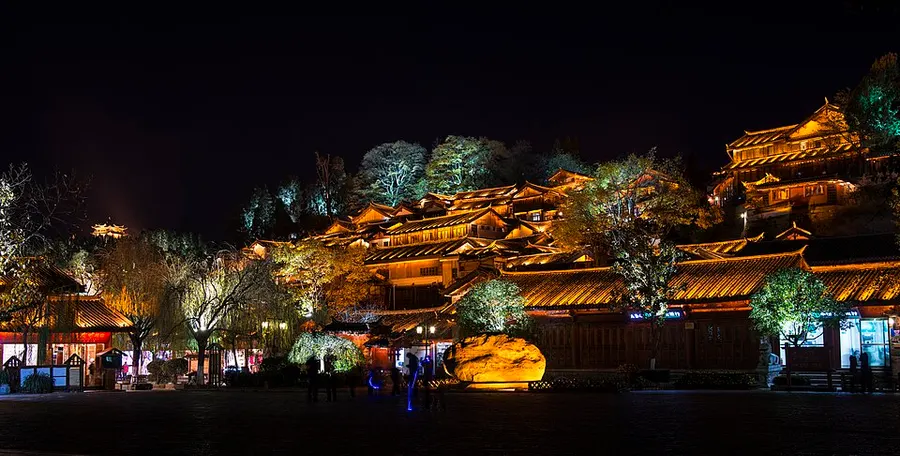
World heritage crowns the map. Three Parallel Rivers protected the upper Yangtze, Mekong, and Salween gorges in 2003; Stone Forest karst joined South China Karst in 2007; Lijiang's wooden old town, home of pictographic Dongba script, was listed in 1997; and Yuanyang's Hani rice terraces, sculpting slopes for thirteen hundred years, followed in 2013 with flights of stairs descending thirty-seven hundred levels.
Cultural Traditions
- 01
Caravan Memory
Museums retrace tea horse caravans that traded leaf for sturdy mountain ponies.
- 02
Terrace Agriculture
Hani farmers flood mirrors of red rice each spring, feeding duck and fish within the paddies.
- 03
Dongba Scribes
Naxi priests still write ritual books in the world's last living pictographic script.
Common Questions
How many ethnic groups live in Yunnan?
Twenty-five minorities with populations over six thousand, fifteen of them unique to the province.
What started the Tea Horse Road?
Pu'er tea demand on the plateau; caravans from Xishuangbanna trekked weeks toward Lhasa exchanging leaf for horses.
Why are Yuanyang terraces famous?
Thirteen centuries of Hani engineering turned entire mountains into flooded staircases, World Heritage since 2013.