Traditional Dance
Yunnan Province, Southwest China
Han Dynasty (202 BCE–220 CE)
National Heritage
Master-Apprentice
Dai Peacock Dance Techniques
Dai Peacock Dance
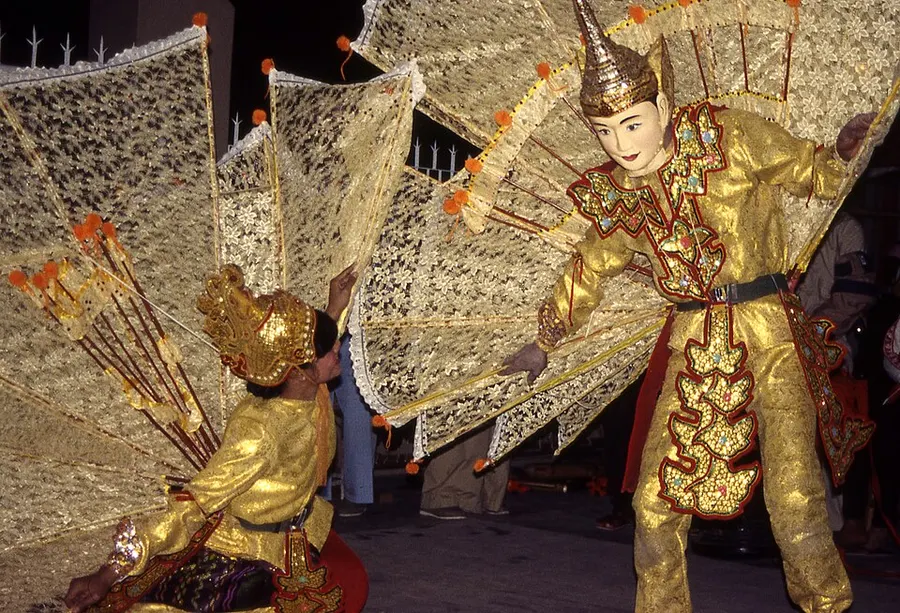
"An elegant Dai ethnic dance imitating peacock movements, performed in elaborate costumes during the Water-Splashing Festival."
CIVILIZATION CONTEXT
This artifact is part of the Intangible Heritage Cluster. It connects to 9 entities across the atlas, spanning 2 regions, 1 master, 0 festivals, and 1 skill.
Dai Peacock Dance: A Living Heritage
The Dai Peacock Dance is a traditional dance of the Dai ethnic group in Yunnan Province, imitating the elegant movements of peacocks. Dancers wear elaborate peacock costumes adorned with silver headdresses and perform graceful gestures — bending, preening, fanning tail feathers, and drinking water. The dance is central to the Dai Water-Splashing Festival and embodies the Dai people's reverence for the peacock as a symbol of beauty, peace, and good fortune.
2228+
Years of Unbroken Lineage
1
Related Cultural Vectors
History & Development
The peacock dance is the Dai people's translation of their holiest bird into human movement. In Dai Buddhist lore the peacock guards scripture and carries peace, and temple murals across Yunnan's Ruili and Xishuangbanna basins show it beside pagodas long before stage choreography existed. Early forms were danced by men in frame-drum accompaniment, wearing feathered harnesses that opened and closed; the dance mimics the bird's drink, bathe, preen, and strut, each phrase a sentence in a courtship grammar every Dai child reads fluently.
Mao Xiang, a Dai dancer born in 1944, rebuilt the form for the stage and for the world. After studying with folk masters in the 1960s she distilled the peacock's gestures into a solo vocabulary of soft hand forms and triple-bend postures, and her 1980s peacock solos, followed by Yang Liping's 1986 "Spirit of the Peacock," fixed the image for a generation. The dance entered the national inventory in 2006, and Ruili's peacock-dance festivals now stage both the old masked village form and the stage lineage side by side, the triple-bend silhouette unmistakable in either.
How It Is Made
- 01
Holding the triple bend
Knee, hip, and wrist curve in one S-line; the posture is the dance's alphabet and beginners hold it for minutes before moving.
- 02
Shaping the hand
Thumb and index touch to form the beak while other fingers fan as plumage, turning each hand into half a bird.
- 03
Drinking and bathing phrases
Choreography quotes real peacock behaviour: the side-step drink, the wing-shake bath, each quoted with exact rhythm.
- 04
Playing the elephant-foot drum
Dancers often drum while dancing, the gourd drum's deep pulse setting the swaying tempo the peacock phrases ride on.
Common Questions
Who made the peacock dance famous?
Dai master Mao Xiang systematised the vocabulary and Yang Liping globalised it; the lineage is traced in our Yang Liping profile.
Is it a religious dance?
Its imagery is Buddhist, tied to temple murals and scripture-guarding lore, but performance occasions are festive, especially the summer festival season and the Dai Water-Splashing New Year.
What is the triple bend?
The signature S-curve through knee, hip, and wrist; it imitates the peacock's silhouette and appears in every phrase, from strut to preen.
Watch & Learn
Stories & Legends
Silk: The Thread That Connected Civilizations
historicalThe humble silkworm created the world's first global trade network.
Skills & Techniques
Dai Peacock Dance Techniques expand_more
The art of imitating peacock movements through graceful dance steps, hand gestures, and body postures inspired by the majestic bird.
Steps
- Begin with the "peacock awakening" posture — slow opening of the arms like spreading wings
- Perform the "peacock drinking water" — bending forward from the waist with a sweeping arm gesture
- Execute "peacock preening" — delicate finger movements tracing along the costume
- Dance the "peacock strutting" — proud, measured steps with lifted chin
- Complete with the "peacock displaying" — spreading the tail-feather skirt in a full circle
Tools
peacock feather costume, silver headdress, metal belt, long silk sash
Materials
silk fabric, peacock feathers, silver ornaments, colorful thread
Generations Preserved
Yang Liping
Yang Liping is China's most famous Dai Peacock Dance performer, who rose to national prominence with her iconic "Spirit of the Peacock" performance. Born in Dali, Yunnan, she has dedicated her career ...
Relationship Constellation
Tracing the invisible threads that connect Dai Peacock Dance to the broader civilization ecosystem.
Continue the Journey
Dai Peacock Dance
Traditional Dance
Tibetan Guozhuang Dance
Traditional Dance
arrow_forwardYi Alili Dance (Axi Tiaoyue)
Traditional Dance
arrow_forwardMongolian Felt Art
Traditional Crafts
arrow_forward