Traditional Dance
Xinjiang Uyghur Autonomous Region, Northwest China
Joseon Dynasty (1392–1910 CE)
Representative List
Master-Apprentice
Oral Tradition
Farmers' Dance of the Korean Ethnic Group
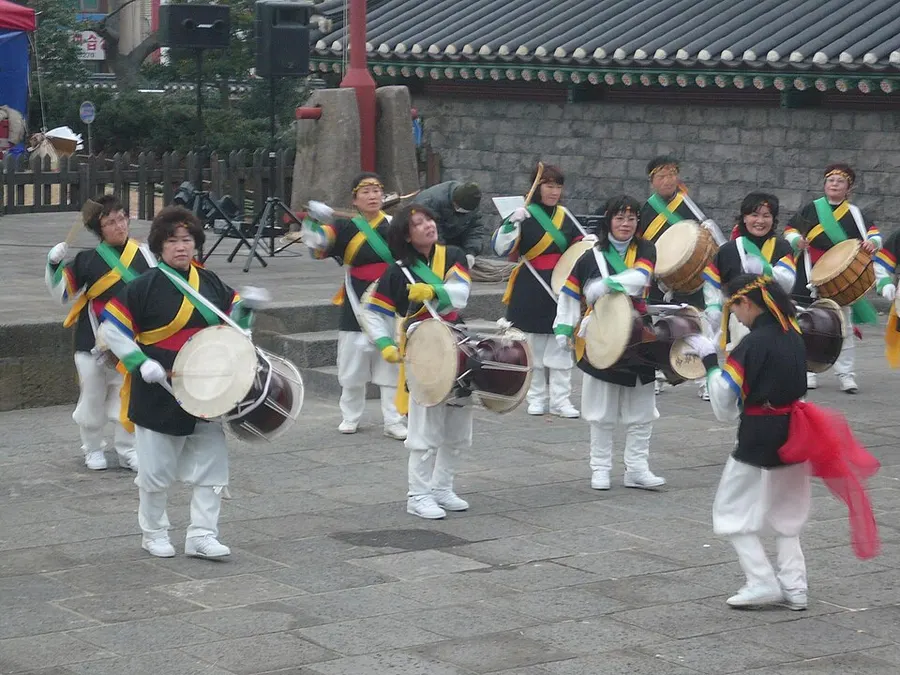
"A jubilant Korean-Chinese dance with spinning hat ribbons, drumming, and singing — originally a harvest ritual, now a festival favorite."
CIVILIZATION CONTEXT
This artifact is part of the Intangible Heritage Cluster. It connects to 5 entities across the atlas, spanning 1 region, 0 masters, 0 festivals, and 0 skills.
Farmers' Dance of the Korean Ethnic Group: A Living Heritage
The Farmers' Dance (nongak) of the Korean ethnic group in northeast China is a vibrant outdoor performance combining dancing, drumming, and singing. Performers wear colorful costumes and spin long ribbon streamers from their hats. Originally a village ritual for good harvests, it evolved into a celebratory art form performed during festivals and community events in Jilin and Liaoning provinces.
116+
Years of Unbroken Lineage
0
Related Cultural Vectors
History & Development
Nongak, the Korean farmers' dance, is percussion choreography born from field labour and village mutual aid. Rooted in the Korean peninsula's agrarian rites and carried into China's northeast frontier by the Joseon-era Korean diaspora, it binds a pungywak percussion band, a fluttering farmer's flag, and dancers whose hats spin long paper streamers. The music's twelve-beat cycles descend from shamanic and military band traditions, and each village troupe historically doubled as a work brigade, playing the same rhythms to pace transplanting and threshing.
In China it was formalised as the Korean ethnic farmers' dance of Yanbian and entered the national inventory through the 2008 second batch. Yanbian Korean Autonomous Prefecture in Jilin province keeps the tradition in schools and festival troupes, with the sangmo spin, the long ribbon whirled from a hat tassel, as its signature image. The 2014 UNESCO inscription of nongak in the Republic of Korea raised the art's international profile, and Chinese-Korean troupes now tour with the same twelve-beat engine, their brass gongs cutting through winter air at every ethnic festival.
How It Is Made
- 01
Sounding the four instruments
Gong, small gong, hourglass drum, and barrel drum map to the four directions, their interlocking patterns forming the twelve-beat cycle.
- 02
Spinning the sangmo
Dancers build centrifugal figure-eights with the head so the 4-metre paper ribbon draws unbroken circles overhead.
- 03
Marching the sitgut
The lead flag-bearer signals formations; sitting and standing sequences alternate, each transition cued by a gong crash.
- 04
Closing the pan-gut
All-night village finales dissolve formation into solo showcases, each drummer taking the centre to trade breaks with the small gong.
Common Questions
Is this the same as Korean samulnori?
Samulnori is the 1978 concert stage adaptation of four nongak instruments; the farmers' dance keeps the marching, spinning, and village-procession context, as covered in our Korean ethnic group profile.
Why the farming flag?
The nonggi flag honours the farm god and marks the troupe as a work team, a reminder that the dance once organised shared labour.
Where can I see it in China?
Yanbian's autumn harvest festivals and Longjing's Korean schools stage full troupes, typically around the summer festival season and Chuseok-equivalent holidays.
Watch & Learn
Stories & Legends
The Lute That Crossed the Desert: Pipa
historicalA Persian instrument that crossed the Silk Road and became unmistakably Chinese.
Related Places
Relationship Constellation
Tracing the invisible threads that connect Farmers' Dance of the Korean Ethnic Group to the broader civilization ecosystem.
Continue the Journey
Farmers' Dance of the Korean Ethnic Group
Traditional Dance
Gesar Epic Tradition
Quyi
arrow_forwardGrand Song of the Dong Ethnic Group
Traditional Music
arrow_forwardSericulture and Silk Craftsmanship
Traditional Crafts
arrow_forward