Quyi
Tibet Autonomous Region, Southwest China
11th–12th century CE, Tibet
Representative List
Master-Apprentice (Oral/Aural)
Oral Tradition
Gesar Epic Tradition
"The world's longest living oral epic — over a million verses recounting the heroic deeds of King Gesar, sung by Tibetan storytellers."
CIVILIZATION CONTEXT
This artifact is part of the Intangible Heritage Cluster. It connects to 13 entities across the atlas, spanning 1 region, 1 master, 0 festivals, and 0 skills.
Gesar Epic Tradition: A Living Heritage
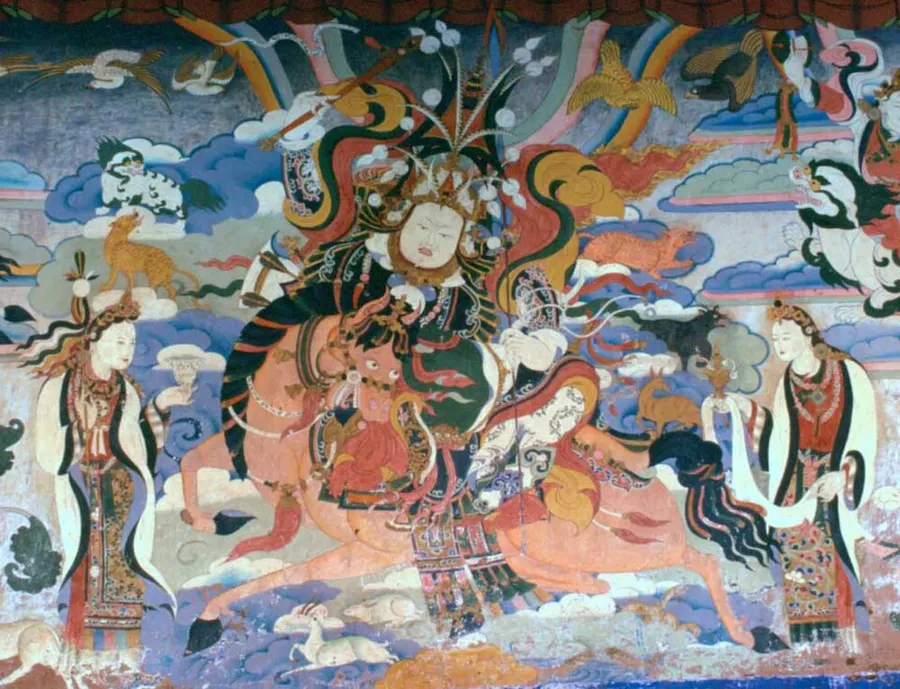
The Epic of King Gesar is the world's longest living oral epic, with over 100 episodes and 1 million verses passed down by Tibetan and Mongolian storytellers. It recounts the heroic deeds of King Gesar, a legendary warrior-king who battled demons and united tribes. Performers (sgrung-mkhan) chant the epic in a distinctive style, often entering a trance-like state. It remains a living tradition performed across the Tibetan Plateau.
Centuries
Years of Unbroken Lineage
0
Related Cultural Vectors
History & Development
The Epic of King Gesar ranks as the world's longest living epic, recounting the warrior king's battles against demon kingdoms across more than a hundred recorded volumes. Tibetan bards called babdrup claim dreams deliver episodes whole, improvising hours of verse in ancient metre without manuscripts on their laps.
Communities across Tibet, Qinghai, and Mongolia have chanted Gesar for centuries, printing woodblock editions alongside oral transmission. UNESCO inscribed Gesar epic performance on the Representative List in 2009, and state academies now archive hundreds of singers whose variants differ from valley to valley.
How It Is Made
- 01
Receiving the dream call
Many bards begin after illness or vision dreams, waking with episodes they say were installed rather than learned.
- 02
Holding the metres
Performance alternates nine-syllable verse, sung passages, and prose bridges, requiring breath plans measured in hours.
- 03
Improvising new chapters
Skilled singers extend known plots into fresh battles overnight, judged by elders on consistency with canon logic.
- 04
Performing with ritual props
Mirror, rosary, or hat gestures cue scene shifts, and some openings require consecration rites before the first line.
Common Questions
How long is the epic really?
Recorded collections exceed a million lines and counting, since living bards keep adding variants, a scale unmatched among world epics celebrated across Tibetan communities.
Are there written texts?
Yes, woodblock and manuscript editions exist, but performance remains oral, and printed volumes preserve only a slice of circulating versions documented around Qinghai archives.
Why dream delivery?
Scholars read it as memory culture: deep childhood listening surfaces as inspiration, legitimising innovation while crediting sacred sources.
Watch & Learn
Stories & Legends
Tibetan Opera: Masks of the Himalayas
historicalAt 4,000 meters, a masked opera has been performed for over 600 years.
Related Places
Generations Preserved
Sangzhub
Sangzhub is one of the most renowned Gesar epic storytellers (sgrung-mkhan) from the Tibetan Plateau. She began chanting the Epic of King Gesar as a child and has memorized over 40 episodes. Her perfo...
Relationship Constellation
Tracing the invisible threads that connect Gesar Epic Tradition to the broader civilization ecosystem.