Traditional Music
Xinjiang Uyghur Autonomous Region, Northwest China
Developed over centuries along the Silk Road
Representative List
Master-Apprentice (Oral/Aural)
Oral Tradition
Uyghur Muqam of Xinjiang
"A grand musical tradition from Xinjiang blending folk songs, dances, and instrumental music — the cultural soul of the Uyghur people."
CIVILIZATION CONTEXT
This artifact is part of the Intangible Heritage Cluster. It connects to 11 entities across the atlas, spanning 1 region, 1 master, 0 festivals, and 0 skills.
Uyghur Muqam of Xinjiang: A Living Heritage
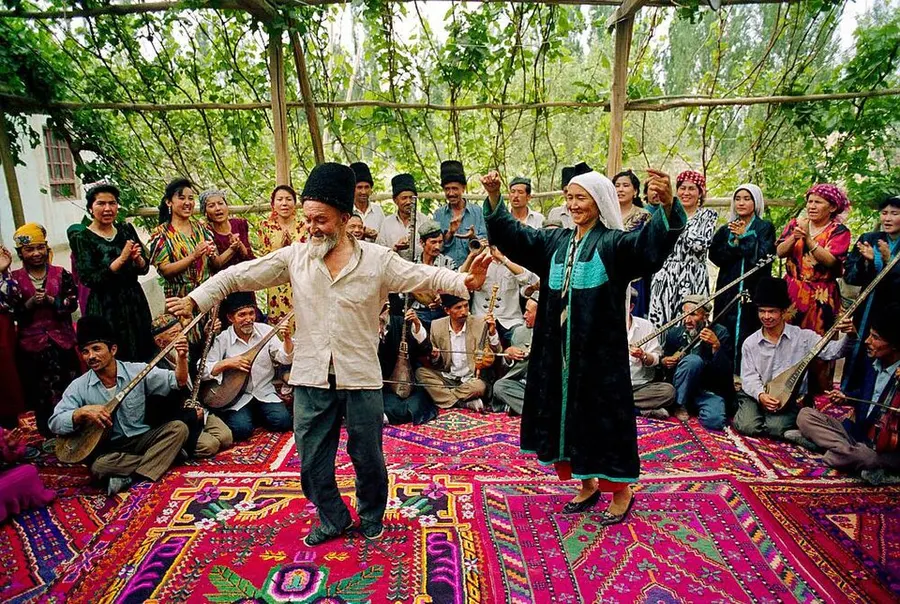
The Uyghur Muqam is a comprehensive musical form performed throughout the Xinjiang Uyghur Autonomous Region. It integrates folk songs, dances, and instrumental music with a rich repertoire of over 300 melodies. Passed down through oral tradition, the Muqam embodies the cultural identity of the Uyghur people and draws on centuries of Silk Road cultural exchange.
Centuries
Years of Unbroken Lineage
0
Related Cultural Vectors
History & Development
The Twelve Muqam chain sung poetry, instrumental interludes, and dance tunes into twelve grand suites whose complete performance runs more than twenty hours. Tradition credits Queen Amannisa Khan's sixteenth-century Yarkand court with gathering and standardising the suites from older regional modes circulating along the Silk Road oases.
Folk singer Turdi Akhun recorded the entire cycle for state archives in the 1950s, rescuing melodies that oral transmission had scattered, and scholars published the notated score in 1960. UNESCO proclaimed the Uyghur Muqam a Masterpiece of Oral and Intangible Heritage in 2005, moving it to the Representative List in 2008.
How It Is Made
- 01
Opening the mukaddime
Each suite begins with a free-rhythm vocal prelude that states the mode, letting the soloist stretch phrases before any percussion enters.
- 02
Sequencing songs and dances
The muqamchi chains song groups into dance sections whose tempo accelerates toward the closing, demanding memorised control of shifting meters.
- 03
Doubling the vocal line
Rawap and dutar players ornament the melody in parallel, their plucked tremolos filling space between sung phrases.
- 04
Keeping the cycle
A dap frame drummer marks the metric cycles with layered strokes, guiding dancers who spin faster as each suite drives to its close.
Common Questions
How long is a complete performance?
All twelve suites exceed twenty hours, so concerts present single muqams or selected songs, while full cycles survive through recordings and multi-day community events.
Which instruments define the sound?
The rawap's buzzing plucked tone leads melody, the long-necked dutar adds bass pulses, and the dap frame drum anchors rhythm, with violin and cello joining modern stage arrangements.
Where does muqam live outside the concert hall?
Neighborhood meshrep gatherings keep the dance tunes social, a custom explored under the meshrep gathering tradition that UNESCO also recognised in 2010.
Watch & Learn
Stories & Legends
The Lute That Crossed the Desert: Pipa
historicalA Persian instrument that crossed the Silk Road and became unmistakably Chinese.
Related Places
Generations Preserved
A Mana
A Mana is a master of Uyghur Muqam from the Kashgar region of Xinjiang. She began learning the twelve Muqam suites from master Seitwali at age 15 and has performed across Xinjiang and internationally....
Relationship Constellation
Tracing the invisible threads that connect Uyghur Muqam of Xinjiang to the broader civilization ecosystem.
Continue the Journey
Uyghur Muqam of Xinjiang
Traditional Music
Urtiin Duu — Mongolian Long Song
Traditional Music
arrow_forwardChinese Calligraphy
Traditional Crafts
arrow_forwardChinese Wrestling (Shuai Jiao)
Traditional Sports
arrow_forward