Traditional Sports
Beijing, North China
Xia Dynasty (c. 2000 BCE), oracle bone records
National Heritage
Master-Apprentice
Oral Tradition
Chinese Wrestling (Shuai Jiao)
"China's ancient martial art of wrestling, emphasizing speed and technique over brute strength — a military art turned competitive sport."
CIVILIZATION CONTEXT
This artifact is part of the Intangible Heritage Cluster. It connects to 6 entities across the atlas, spanning 1 region, 0 masters, 0 festivals, and 0 skills.
Chinese Wrestling (Shuai Jiao): A Living Heritage
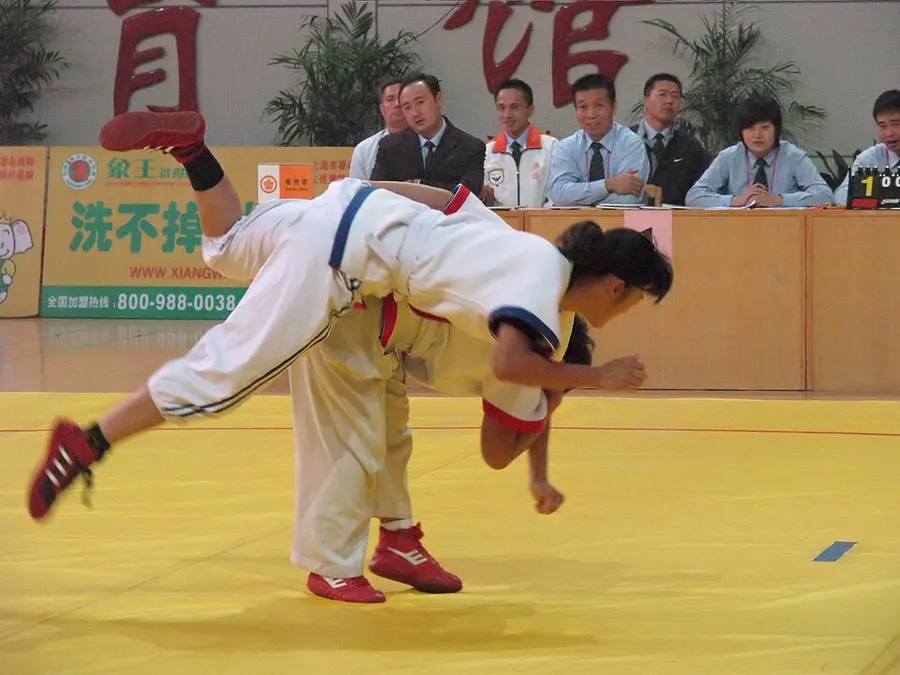
Shuai jiao is the traditional Chinese martial art of wrestling, with a history spanning over 4,000 years. Originating as a military training technique, it evolved into a competitive sport during the Zhou Dynasty. Practitioners wear a distinctive jacket (jiaoxie) and belt, using throws, trips, and sweeps to put the opponent on the ground. Unlike sumo, shuai jiao emphasizes speed, leverage, and technique over mass.
4026+
Years of Unbroken Lineage
0
Related Cultural Vectors
History & Development
Chinese wrestling grew from Han-dynasty horn-butting spectacles into shuai jiao, where jacket grips, leg hooks, and instant throws score points on any touch of earth beyond the feet. The Qing court maintained an elite wrestling battalion whose graduates taught Beijing alleyways, seeding the guild halls that kept matches running through the twentieth century.
Regional styles favour different grips, from Beijing jacket work to Mongolian-influenced open-chest holds seen at Naadam arenas, and ethnic-minority tournaments keep herder traditions alive. Modern leagues unified rules for weight-class competition, and coaching academies archive the battalion-era techniques on video for the first time.
How It Is Made
- 01
Gripping the jacket
Fighters seize lapel and sleeve first, controlling posture before any throw attempt, since a lost grip means lost initiative.
- 02
Breaking balance
Foot sweeps and hip bumps nudge opponents onto one heel, creating the half-second window every scoring throw requires.
- 03
Throwing with technique over force
Leg hooks, waist twists, and arm levers convert the opponent's push into flight, letting lighter wrestlers beat heavier ones cleanly.
- 04
Falling safely
Classes begin with breakfall drills on mats, conditioning shoulders and slapping arms so decades of matches leave bodies intact.
Common Questions
What is shuai jiao exactly?
China's native wrestling style, fought in jackets and belts where throws alone decide the bout, distinct from ground-grappling imports.
How does it relate to Mongolian wrestling?
Court exchanges shaped both; herder-style bouts still appear at steppe festivals profiled in the Mongol community guide, sharing toppling logic with steppe performance arts.
Can adults start late?
Recreational classes accept beginners past middle age because drilling emphasises footwork and falls before live throwing.
Watch & Learn
Stories & Legends
The Art of Silence: Peking Opera's Journey from Court to World
historicalIn a Peking Opera performance, every gesture tells a story.
Related Places
Relationship Constellation
Tracing the invisible threads that connect Chinese Wrestling (Shuai Jiao) to the broader civilization ecosystem.
Continue the Journey
Chinese Wrestling (Shuai Jiao)
Traditional Sports
Uyghur Muqam of Xinjiang
Traditional Music
arrow_forwardUrtiin Duu — Mongolian Long Song
Traditional Music
arrow_forwardTuina Massage
Traditional Medicine
arrow_forward