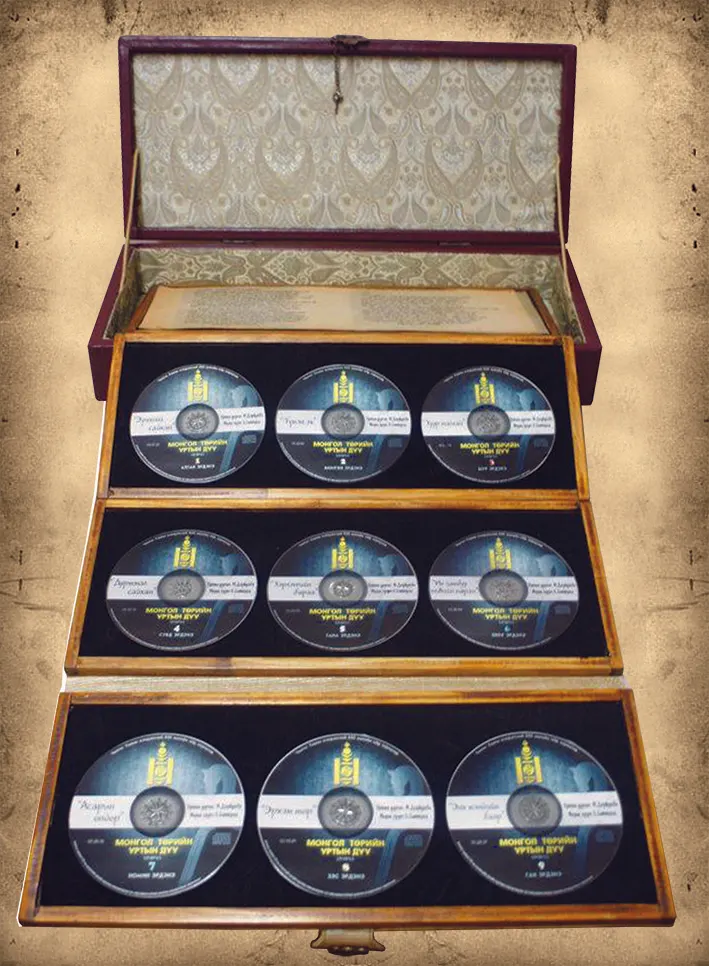
Traditional Music
Inner Mongolia Autonomous Region, North China
Ancient, several centuries before the Mongol Empire
Representative List
Master-Apprentice (Oral/Aural)
Oral Tradition
Urtiin Duu — Mongolian Long Song
"A breathtaking Mongolian vocal tradition of sustained notes and elaborate ornamentation — the soulful voice of the grasslands."
CIVILIZATION CONTEXT
This artifact is part of the Intangible Heritage Cluster. It connects to 10 entities across the atlas, spanning 1 region, 0 masters, 0 festivals, and 0 skills.
Urtiin Duu — Mongolian Long Song: A Living Heritage
Urtiin Duu, or "long song," is a traditional Mongolian vocal form characterized by extended, sustained notes and elaborate ornamentation. Each syllable of text is stretched over a long melodic line, expressing themes of grassland life, horses, and spiritual connection to nature. Sung without instrumental accompaniment, it requires extraordinary breath control and is performed at festivals, weddings, and horse-racing ceremonies.
Centuries
Years of Unbroken Lineage
0
Related Cultural Vectors
History & Development
Mongolian long song, urtin duu, stretches single syllables across wide melodic intervals so one phrase fills a single deep breath, a style shaped by the open steppe where sound travels unbroken. Singers ornament long tones with trills that imitate horse gaits and wind, and herders open weddings and Naadam festivals with ceremonial long songs.
China and Mongolia jointly proclaimed the tradition a UNESCO Masterpiece in 2005, moving it to the Representative List in 2008. Inner Mongolia conservatories now grant degrees in long song, and regional canons preserve several hundred classical songs whose court and ritual versions survive with named lineages.
How It Is Made
- 01
Building breath capacity
Singers train abdominal support until one breath sustains a phrase for half a minute, because breaking mid-tone breaks the song's architecture.
- 02
Shaping long tones
The voice holds a central pitch, then circles it with slow trills and glides that give each syllable its rolling, galloping character.
- 03
Riding the morin khuur
A horsehead fiddle doubles the melody a beat behind, its bowing mimicking the singer's ornaments in dialogue rather than simple accompaniment.
- 04
Memorising the canon
Ceremonial songs belong to specific occasions, so students learn which piece opens a wedding, which honours a guest, and which may never be sung casually.
Common Questions
Why is it called long song?
Length refers to each syllable, not the piece; a single word can unfurl for ten seconds, stretching a three-verse song far beyond ordinary folk melodies.
Who carries the tradition today?
Pastoral-trained singers such as Baatarchuluun perform the ceremonial canon, while Hohhot academies graduate new cohorts, both documented in the Inner Mongolia region guide.
How is it different from short song?
Short songs follow regular metre for dancing and daily life, while long song floats free of strict rhythm, its tempo set by breath and landscape rather than a drum.
Watch & Learn
Stories & Legends
Mongolian Long Song: The Grasslands Singing
historicalA melody as vast as the steppe, born among the nomads of Inner Mongolia.
Related Places
Relationship Constellation
Tracing the invisible threads that connect Urtiin Duu — Mongolian Long Song to the broader civilization ecosystem.
Continue the Journey
Urtiin Duu — Mongolian Long Song
Traditional Music
Chinese Calligraphy
Traditional Crafts
arrow_forwardChinese Timber-framed Architecture
Traditional Crafts
arrow_forwardUyghur Muqam of Xinjiang
Traditional Music
arrow_forward