河北省
Hebei Province
Surrounding Beijing, Hebei Province has a rich tradition of folk martial arts, including Duanquan boxing, as well as shadow puppetry and folk craft traditions.
As a vital node in China's cultural geography, this location has nurtured artistic traditions that have endured through dynastic changes, social transformations, and the challenges of modernity. The continuity of these practices speaks to the deep relationship between place and cultural identity.
Today, Hebei Province continues to be a living center of heritage — where master artisans train the next generation, festivals mark the seasons, and ancient crafts adapt to contemporary life.
Civilization Snapshot
Where heritage lives — the geography of cultural practice
Interact with the nodes of cultural heritage across the region's ancient grid.
Heritage District
The cultural heart of Hebei Province
Craft Village
Traditional workshops and living heritage
The heritage collection of Hebei Province
A Lineage of Eras
Keepers of the Flame
Master Artisan
“The craft is not just technique — it is the memory of our ancestors speaking through our hands.”
EXPLORE MASTERSMaster Artisan
“The craft is not just technique — it is the memory of our ancestors speaking through our hands.”
EXPLORE MASTERSThe Cultural Constellation of Hebei Province
The heritage of Hebei Province does not exist in isolation. It is the core of a sophisticated network of exchange, where techniques, motifs, and melodies traveled to shape the identity of an entire civilization.
- Beijing Connected Heritage
- Nanjing Connected Heritage
- Suzhou Connected Heritage
The Rhythms of Time
Spring Festival
2 seasonal observances
Summer Festival
2 seasonal observances
Autumn Festival
2 seasonal observances
Winter Festival
2 seasonal observances
Nearby heritage destinations
Beijing
北京 · The capital of China, Beijing has been the political and cul...
Nanjing
南京 · An ancient capital of six dynasties, Nanjing is the birthpla...
Suzhou
苏州 · Famous for its classical gardens and silk industry, Suzhou i...
Chenjiagou
陈家沟 · A small village in Henan Province, Chenjiagou is the birthpl...
History & Development
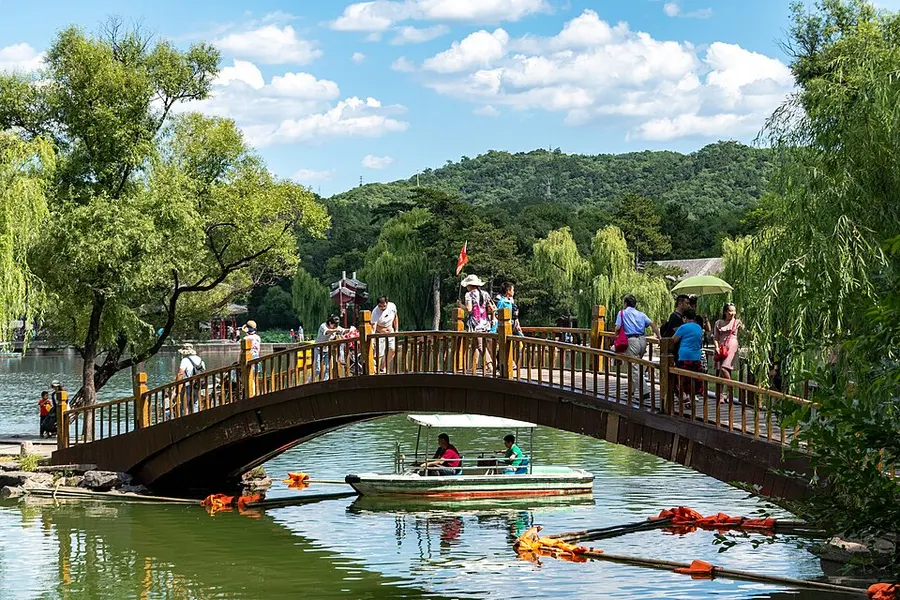
Hebei wraps around Beijing and Tianjin, the only province touching sea, plain, lakeshore, and plateau. Its Chengde Mountain Resort absorbed eighty-nine years of Qing landscaping between 1703 and 1792, pairing a summer capital with eight Tibetan-style Outer Temples that hosted Mongol and Tibetan dignitaries; UNESCO listed the ensemble in 1994.
Engineering landmarks stud the province. Shanhaiguan, where the Great Wall meets the Bohai Sea, earned the plaque "First Pass Under Heaven" in 1381. Anji Bridge at Zhaozhou, raised by craftsman Li Chun around 605, remains the world's oldest open-spandrel stone arch still standing, fourteen centuries of floods and earthquakes notwithstanding. Cangzhou wrestlers and Wuqiao acrobat families round out a reputation for physical prowess.
Cultural Traditions
- 01
Resort Gardens
Kangxi personally approved the seventy-two scenic views blending Jiangnan waterways and grassland hunting fields.
- 02
Paper-Cut Pointillism
Yuxian cutters knife-carve then dye window flowers in translucent vermillion.
- 03
Fast Wrestling
Baoding rings teach shuai jiao throws in jackets gripped by cotton loops.
Common Questions
What is Chengde Mountain Resort?
The Qing emperors' summer palace and gardens outside Beijing, built 1703-1792 and World Heritage since 1994.
How old is Zhaozhou Bridge?
About fourteen hundred years; its pierced spandrels pioneered a design now standard worldwide.
Where does the Great Wall touch the sea?
At Laolongtou in Shanhaiguan, Hebei, where ramparts run into the surf.