Traditional Crafts
Beijing, North China
Han Dynasty (202 BCE–220 CE), flourished in Ming and Qing
National Heritage
Master-Apprentice (Hands-on)
New Year Woodblock Print Making
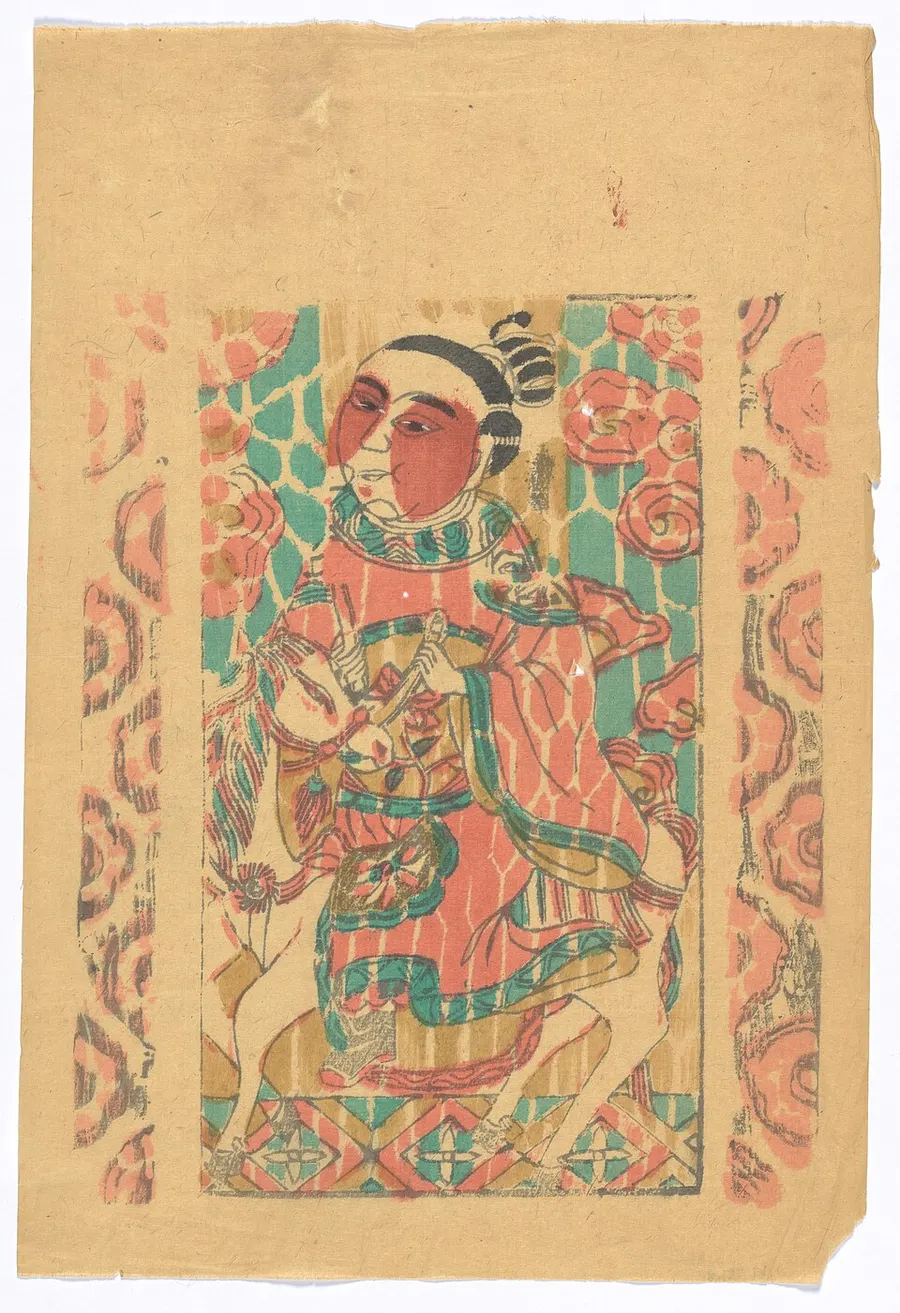
Chinese New Year Woodblock Prints
"Colorful folk woodblock prints pasted on doors at New Year — each region's unique style of auspicious imagery and door gods."
CIVILIZATION CONTEXT
This artifact is part of the Intangible Heritage Cluster. It connects to 8 entities across the atlas, spanning 1 region, 1 master, 1 festival, and 1 skill.
Chinese New Year Woodblock Prints: A Living Heritage
Chinese New Year woodblock prints (nianhua) are colorful folk prints pasted on doors and walls during Spring Festival to bring good luck and ward off evil. Produced in regional centers like Yangliuqing (Tianjin), Taohuawu (Suzhou), and Yangjiabu (Shandong), each style has distinctive characteristics. Traditional subjects include door gods, the God of Wealth, auspicious children, and harvest scenes. The prints are created using hand-carved wooden blocks and bright mineral pigments.
2228+
Years of Unbroken Lineage
1
Related Cultural Vectors
History & Development
New Year pictures pasted doors and walls with guardian gods, omens of harvest, and folk opera scenes, turning the whole house into an annual gallery. Print centres specialised by taste: Yangliuqing near Beijing refined half-painted refinement, Suzhou's Taohuawu served the Jiangnan market with elegant city scenes, Zhuxianzhen of Kaifeng kept bold archaic colour, and Mianzhu in Sichuan supplied the southwest. Door god pairs like Qin Qiong and Yuchi Gong guard thresholds, their fierce faces painted on paper exactly as they were once carved on gates.
The genre fed and borrowed from theatre and legend, and its imagery encodes the festival calendar itself, from kitchen god ascents to the monster-scaring red of the New Year, a tale retold in our Nian story. Leading centres entered China's first national inventory batch in 2006, and workshops still cut new blocks each autumn; collectors meanwhile chase Qing originals, whose pigments and paper preserve festival moods from vanished streetscapes.
How It Is Made
- 01
Cutting the outline block
The master block carries contour lines; colour blocks follow, one per pigment, keyed to register marks.
- 02
Printing the colours
Five to nine impressions layer yellow, crimson, green, and purple in strict order, each pulled by hand rub.
- 03
Adding the paintbrush
Yangliuqing finishes faces and folds by brush, blending printed structure with painted softness.
- 04
Pasting at year's turn
Households raise fresh prints on the twentieth-eighth lunar day, retiring old gods with respect fires.
Common Questions
Why paste door gods?
They bar demons at the threshold, part of the New Year defences told in our Nian monster story.
Which centres matter most?
Yangliuqing, Taohuawu, Zhuxianzhen, Mianzhu, and Foshan head the recognised schools, each listed nationally in 2006.
How are prints timed to the festival?
Markets open in the twelfth month so homes are dressed before New Year's Eve, the climax of the cycle described under Spring Festival.
Watch & Learn
Stories & Legends
Woodblock Printing: The First Information Revolution
historicalHow carved pear wood changed the world, 600 years before Gutenberg.
Skills & Techniques
New Year Woodblock Print Making expand_more
The craft of carving multi-colored woodblocks and printing auspicious images for Spring Festival decorations.
Steps
- Draw the design on paper, separating color areas
- Transfer each color layer to a separate pear wood block
- Carve the outline block first, then color blocks
- Mix mineral pigments with animal glue binder
- Print the outline in black ink on xuan paper
- Print each color block in sequence, aligning registration marks
- Air-dry and trim the finished print
Tools
carving knife set, printing brush, registration frame, pigment tray, mallet, burnisher
Materials
pear wood blocks, xuan paper, mineral pigments, Chinese ink, animal glue
Related Places
Related Festivals
Generations Preserved
Zhang Fang
Zhang Fang is a master of Chinese New Year woodblock print making (nianhua) from Yangliuqing, Tianjin. A fifth-generation print artist, she carves pear wood blocks and prints using traditional mineral...
Relationship Constellation
Tracing the invisible threads that connect Chinese New Year Woodblock Prints to the broader civilization ecosystem.
Continue the Journey
Chinese New Year Woodblock Prints
Traditional Crafts
Dagu (Drum Storytelling)
Quyi
arrow_forwardDongyang Wood Carving
Traditional Crafts
arrow_forwardCuju (Ancient Chinese Football)
Traditional Sports
arrow_forward