
Mei Lanfang
梅兰芳
Mei Lanfang was the most famous Peking Opera performer of the 20th century, renowned for his female lead (dan) roles. He revolutionized Peking Opera by combining traditional techniques with innovative…
Mei Lanfang was the most famous Peking Opera performer of the 20th century, renowned for his female lead (dan) roles. He revolutionized Peking Opera by combining traditional techniques with innovative expressions. He toured the United States, Soviet Union, and Japan, introducing Chinese opera to the Western world. His artistic legacy continues through the Mei School of Performance.
Heritage DNA
Classification
Grand Master
Status
deceased
Year of Birth
1894
Age
132 years
Location
Beijing
Region
North China
Next Master
Mei Baojiu
梅葆玖
See the Craft
in Motion
The Cultural Network
Heritage is not a static artifact; it is a living web. Our mapping engine traces the cross-pollination of techniques across three millennia, revealing how Mei's thread vibrates through the broader tapestry.
Territories of
Heritage
Geography shapes identity. Journey through the historical corridors that defined a civilization, from the arid Silk Road to the lush Tea Horse Road.
Beijing
North China
The Living Masters
The true archive of heritage is found in the hands and minds of those who refuse to let the fire die out.
How Mei Lanfang connects to the broader network of heritage.
The Atlas is Living
Every master is a living archive. Join a collective of explorers, artisans, and scholars dedicated to tracing the vibrant pulse of our shared world.
History & Development
Mei Lanfang (1894-1961) built the international reputation of Peking Opera almost single-handedly. Trained from age eight in the dan female-role repertoire, he refined singing, gesture, and costume into a systematic art that critics called the Mei school, one of the four great dan schools of early twentieth-century Beijing.
His tours to Japan in 1919 and 1924, the United States in 1930, and the Soviet Union in 1935 introduced Chinese staged performance to global audiences. Bertolt Brecht cited Mei's acting after watching him in Moscow when developing the alienation effect, making Mei a rare artist who shaped both Eastern and Western theater theory.
Cultural Traditions
-
Dan Role System
The dan category splits into qingyi virtuous heroines, huashan flirtatious vivacity, daomadan warrior women, and laodan elderly figures, each with codified movement vocabularies.
-
Water Sleeves and Gesture
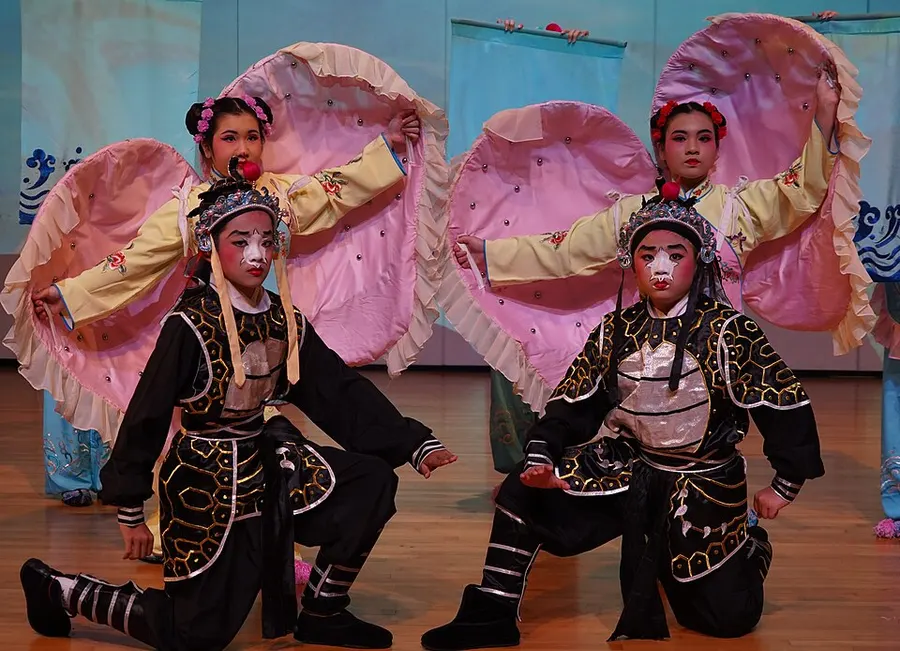
Long silk sleeves extend emotion into visible arcs; a flick signals grief, a coil conceals shame, and every motion follows choreography fixed by generations of performers.
-
Mei School Repertoire
Signature works including The Drunken Beauty and Farewell My Concubine remain core exam pieces for dan students at every Chinese opera academy.
Common Questions
Why is Mei Lanfang considered the face of Peking Opera worldwide?
He was the first Chinese stage artist to tour three continents, and his 1930 American tour earned honorary doctorates from two universities, giving Peking Opera its first sustained Western audience.
What is his connection to the tradition today?
Every student of Peking Opera studies Mei-school pieces, and his descendants and disciples continue to perform his restored productions internationally.