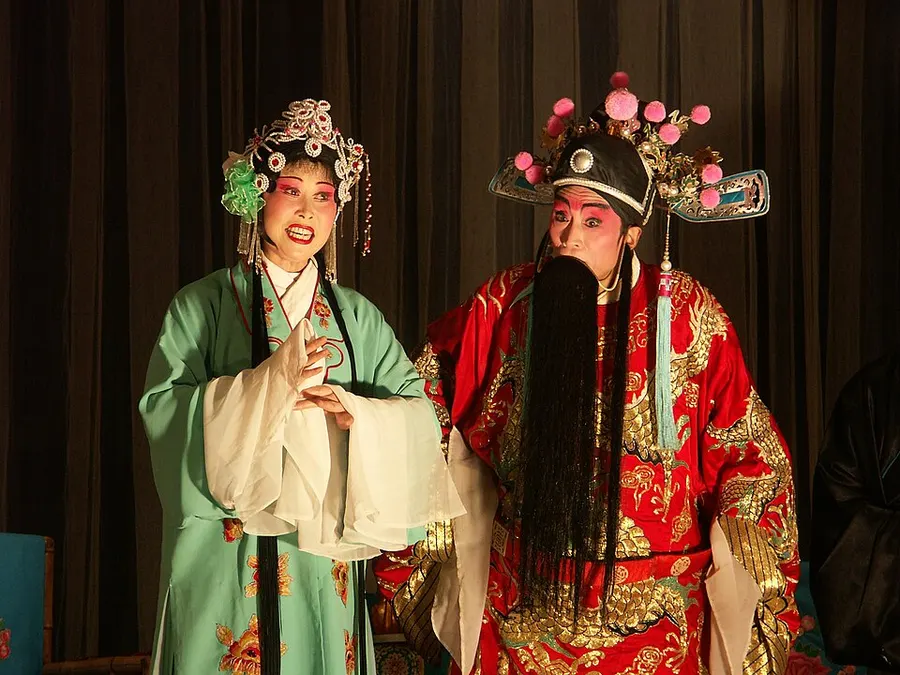
Traditional Drama
Chengdu, Southwest China
Qing Dynasty, 17th–18th century CE
National Heritage
Master-Apprentice (Oral/Aural)
Oral Tradition
Sichuan Opera
"A spectacular regional opera famous for its lightning-fast face-changing masks, lively humor, and acrobatic performances."
CIVILIZATION CONTEXT
This artifact is part of the Intangible Heritage Cluster. It connects to 8 entities across the atlas, spanning 1 region, 0 masters, 0 festivals, and 0 skills.
Sichuan Opera: A Living Heritage
Sichuan Opera is a regional Chinese opera style from Sichuan Province, famous for its "face-changing" (bian lian) technique where performers change masks in the blink of an eye. It combines music, comedy, acrobatics, and storytelling. Unlike the refined elegance of Kunqu, Sichuan Opera is known for its lively humor and stunning visual tricks.
Centuries
Years of Unbroken Lineage
0
Related Cultural Vectors
History & Development
Sichuan opera blends five vocal streams, including high-pitched cymbal-driven bangzi and Kunqu-derived melodies, into a genre famous for theatrical magic: face-changing, fire-spitting, and rolling-lamp stunts. Teahouse stages in Chengdu and Chongqing ran matinees for a century, and guild troupes carried repertoires of thousands of plays.
Face-changing, bianlian, swaps painted silk masks in a blink using techniques masters guard as trade secrets, while comic roles improvise topical jokes between set speeches. The State Council listed Sichuan opera in the first national heritage batch in June 2006, and teahouse theatres now schedule nightly shows for travellers beside local season subscribers.
How It Is Made
- 01
Training the five voices
Singers master high qiang, kun, huqin, tanxi, and lantern styles, switching timbres across a single play's scenes.
- 02
Mastering bianlian
Apprentices spend years on mask mechanics and timing before masters reveal the secret, performing first in distant towns under oaths of silence.
- 03
Spitting fire safely
Spirit characters exhale fuel vapour over flames on cue, a stunt rehearsed with water first until breath control is automatic.
- 04
Playing the teahouse crowd
Clowns read the room and insert local references, a skill no conservatory syllabus fully teaches.
Common Questions
How is face-changing done?
Performers keep the method secret; audiences see only the flick of a sleeve or turn of a head, and even veteran critics cannot trace the swap.
Where should first-timers go?
Chengdu's Shufeng Yayun teahouse runs nightly highlights with subtitles, an easy entry described in the Chengdu city guide.
Does it share roots with Kunqu?
Yes, one of its five voice systems descends from Kunqu opera, which Sichuan troupes absorbed and re-tempered with local percussion.
Watch & Learn
Stories & Legends
The Art of Silence: Peking Opera's Journey from Court to World
historicalIn a Peking Opera performance, every gesture tells a story.
Related Places
Relationship Constellation
Tracing the invisible threads that connect Sichuan Opera to the broader civilization ecosystem.
Continue the Journey
Sichuan Opera
Traditional Drama
Nanyin Music
Traditional Music
arrow_forwardXi'an Wind and Percussion Ensemble
Traditional Music
arrow_forwardTibetan Opera (Ache Lhamo)
Traditional Drama
arrow_forward