Traditional Music
Quanzhou, Southeast China
Tang Dynasty (618–907 CE)
Representative List
Master-Apprentice (Oral/Aural)
Oral Tradition
Nanyin Music
"A living fossil of Tang Dynasty court music, preserved in Fujian's Minnan region with ancient instruments and elegant melodies."
CIVILIZATION CONTEXT
This artifact is part of the Intangible Heritage Cluster. It connects to 10 entities across the atlas, spanning 2 regions, 1 master, 0 festivals, and 0 skills.
Nanyin Music: A Living Heritage
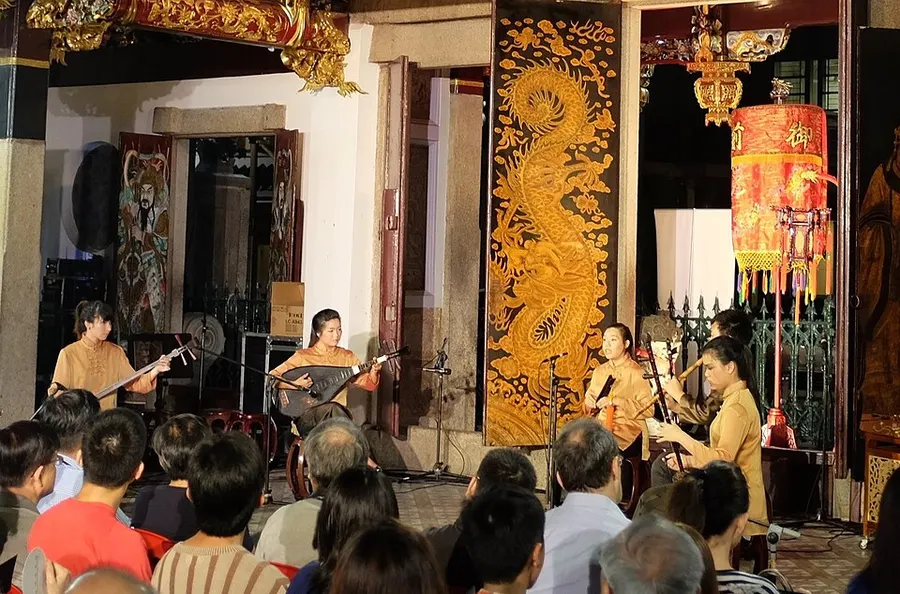
Nanyin, meaning "southern sounds," is a living fossil of ancient Chinese music preserved in the Minnan region of Fujian. Its melodies retain characteristics of Tang Dynasty court music and Song Dynasty poetry recitation. Performed with instruments like the pipa, dongxiao (vertical flute), and erxian (two-stringed fiddle), Nanyin is known for its gentle, elegant melodies and strict performance etiquette.
1119+
Years of Unbroken Lineage
0
Related Cultural Vectors
History & Development
Nanyin preserves the oldest continuously performed chamber music in China, sung in the Quanzhou dialect over texts copied since the Song dynasty. Its ensemble keeps Tang-era instrumentation, with a pipa held horizontally like the musicians carved in Tang tomb figurines, a slender dongxiao vertical flute, an erxian bowed fiddle, and a clapper player who anchors every beat.
The repertoire counts more than two thousand named songs and thirteen instrumental suites, carried overseas by Fujian merchants so that Manila, Singapore, and Kuala Lumpur still run amateur nanyin clubs. UNESCO inscribed Nanyin on the Representative List in 2009, and Quanzhou now funds school classrooms and an annual festival for visiting societies.
How It Is Made
- 01
Reading gongche notation
Singers decode nanyin's own cipher script, which marks pitch skeleton and lyric but leaves ornamentation to the teacher's ear.
- 02
Holding the pipa sideways
The player rests the lute across the lap at a Tang-dynasty angle, striking with a plectrum for the steady, drum-like pulse that grounds the ensemble.
- 03
Ornamenting the vocal line
The singer bends syllables through prescribed turns called qu yun, filling in the melodic detail the notation deliberately omits.
- 04
Balancing the ensemble
Dongxiao breath, erxian slides, and clapper beats interlock around the voice, so members rehearse for years before performing the slow opening suites.
Common Questions
Why does the pipa sit horizontal here?
Nanyin froze the Tang-dynasty playing posture, while mainstream pipa later turned upright for virtuosic fingering. The horizontal hold gives nanyin its steady, plucked-bell rhythm.
Is nanyin only found in Quanzhou?
The homeland is the Quanzhou region, but Fujian diaspora communities carried it across Southeast Asia, where amateur clubs still meet weekly and send singers to the Quanzhou festival described in the Quanzhou port city guide.
How is this pipa different from the modern one?
Nanyin's lute keeps fewer frets, silk strings, and a narrower neck than the modern concert pipa profiled in the pipa tradition, trading brilliance for a rounded, antique voice.
Watch & Learn
Stories & Legends
The Lute That Crossed the Desert: Pipa
historicalA Persian instrument that crossed the Silk Road and became unmistakably Chinese.
Related Places
Generations Preserved
Wang Yuanqi
Wang Yuanqi is a Nanyin musician from Quanzhou, Fujian Province, specializing in the pipa and dongxiao. He leads the Quanzhou Nanyin Ensemble and has performed internationally to introduce this ancien...
Relationship Constellation
Tracing the invisible threads that connect Nanyin Music to the broader civilization ecosystem.
Continue the Journey
Nanyin Music
Traditional Music
Xi'an Wind and Percussion Ensemble
Traditional Music
arrow_forwardHua'er Folk Songs
Traditional Music
arrow_forwardSichuan Opera
Traditional Drama
arrow_forward