menu_book The Full Narrative
01
The Imperial Patronage
In 1790, four Anhui opera troupes arrived in Beijing to perform for the Qianlong Emperor's 80th birthday. They never left. Their fusion of Anhui melodies, Kunqu refinement, and northern acrobatics evolved into what we now call Peking Opera. Imperial patronage elevated the form from street entertainment to a sophisticated art supported by the Qing court.
02
The Language of Gesture
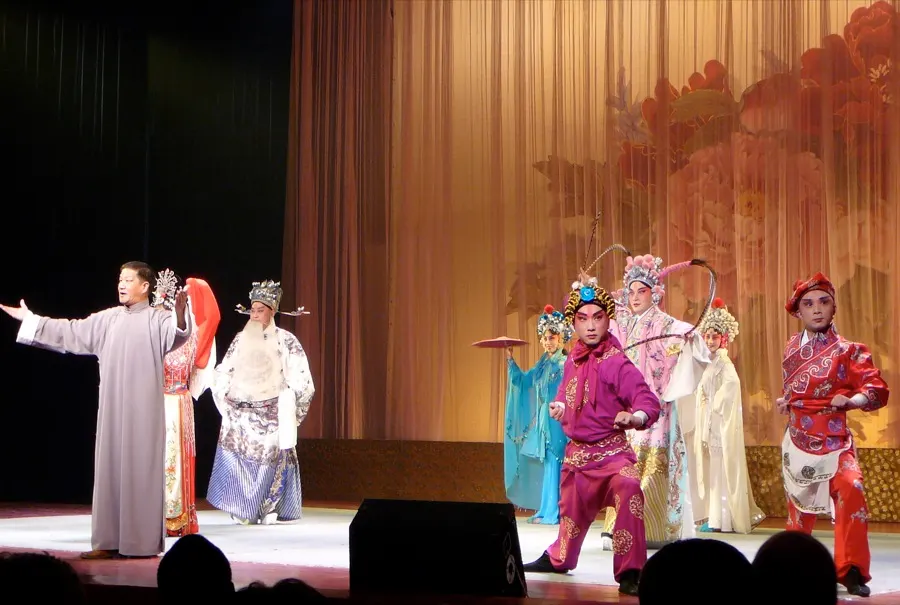
Peking Opera developed an elaborate symbolic vocabulary. A performer holding a whip means riding a horse. A flag with wheels represents a chariot. Four soldiers flanking a general suggest an entire army. This theatrical language allowed Peking Opera to tell epic stories from Chinese history and literature with minimal props but maximal emotional impact.
03
Silence as Expression
Perhaps the most distinctive feature of Peking Opera is its use of silence and stillness. A frozen pose at a dramatic moment — called liangxiang — can hold for several seconds, the performer vibrating with controlled energy. In those moments of perfect stillness, the audience leans forward, captivated by what is not said.
04
Global Recognition
UNESCO inscribed Peking Opera on the Representative List in 2010. Today, it transcends its Beijing origins — performed in New York, Paris, and Tokyo, adapted into films and contemporary theater. Yet its heart remains in the old teahouses of Beijing, where the painted faces still perform the dramas of emperors and warriors.
05
The Mei Lanfang Effect
One actor turned a Beijing stage craft into twentieth-century world theater. Mei Lanfang refined the dan repertoire into a codified system of gesture, costume, and song, then carried it abroad: tours to Japan in 1919 and 1924, America in 1930, and the Soviet Union in 1935. Bertolt Brecht watched those Moscow performances and built his idea of the alienation effect partly on what he saw. The Mei Lanfang dan-role lineage still anchors how the female roles are sung and moved on Chinese stages.
06
Seven Years to Make a Performer
A Peking Opera career begins before adolescence. Students enter specialist schools between nine and twelve years old, then train roughly seven years in singing, speech, combat acrobatics, and dance, starting each morning before dawn with stretches and vocal drills. The four role types of sheng, dan, jing, and chou divide every part an actor will ever play. The system descends from the imperial Tang-era Pear Garden academy, and graduates now staff companies across China alongside regional styles such as Sichuan and Yue opera.
07
Successors Carry the Roles Abroad
Mei Lanfang's successors turned overseas touring into routine statecraft. His son Mei Baojiu reconstructed lost Mei-school productions through the 1990s and led delegations that reopened Western opera houses to jingju after the Cold War pause, insisting on full-length works over excerpt galas. Zhang Huoding's 2015 Lincoln Center debut sold out within hours, the first jingju headline there in over a decade. National companies now schedule foreign tours annually, and conservatory exchange programs place students in overseas residencies lasting whole semesters. Translation surtitles standardized by the Foreign Cultural Bureau removed the language barrier that once confined tours to Chinatown venues. Box office data shows diaspora audiences shrinking as a share while general publics grow, the metric Mei's generation chased but never measured. The lineage continues at home too, where Mei Baojiu's recordings remain reference standards for dan-role training worldwide.