Traditional Music
Beijing, North China
Zhou Dynasty (1046–256 BCE)
Representative List
Master-Apprentice (Oral/Aural)
Oral Tradition
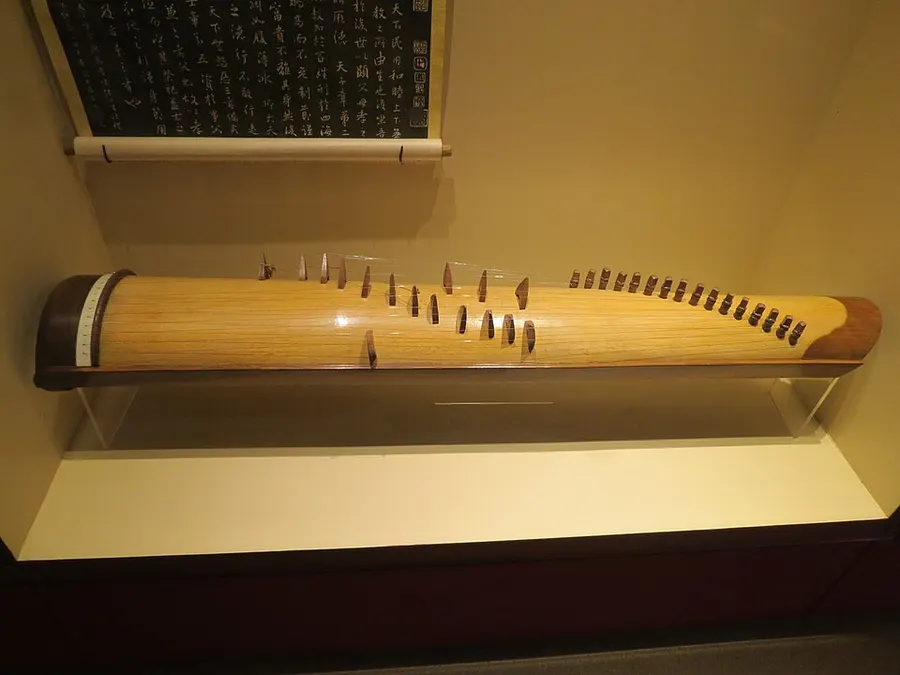
Guqin and Its Music
"An ancient seven-stringed zither beloved by scholars for over 3,000 years, expressing the deepest ideals of Chinese philosophy through music."
CIVILIZATION CONTEXT
This artifact is part of the Intangible Heritage Cluster. It connects to 12 entities across the atlas, spanning 1 region, 1 master, 0 festivals, and 0 skills.
Guqin and Its Music: A Living Heritage
The guqin, a seven-stringed zither, has been played by Chinese scholars and literati for over 3,000 years. More than a musical instrument, the guqin is a vehicle for philosophical expression, associated with Confucian ideals of self-cultivation and harmony. Its music is characterized by subtlety, silence between notes, and deep connection to nature. Inscribed by UNESCO in 2008.
2282+
Years of Unbroken Lineage
0
Related Cultural Vectors
History & Development
The guqin carries the oldest continuous written music tradition in China. A hand-copied scroll of the piece Jieshi Diao Youlan, made during the Tang dynasty and now kept at the Tokyo National Museum, preserves seventh-century fingering notation in readable detail. From that notation lineage, collectors catalogued more than 3,000 historical pieces, of which roughly 150 remain in common performance today.
Confucian scholars ranked the qin first among the four arts of lettered life, beside chess, calligraphy, and painting. Song-dynasty emperors commissioned imperial qin workshops, and Ming princes printed the largest early anthologies of tablature. After a long decline through the twentieth century, UNESCO proclaimed the guqin and its music a Masterpiece of Oral and Intangible Heritage in 2003, moving it to the Representative List in 2008.
How It Is Made
- 01
Selecting the soundboards
Makers split aged paulownia for the top plate and catalpa for the back, then tap each plank and listen for a clear, sustained ring before any carving begins.
- 02
Shaping the body
The two plates are hollowed, joined into a box about 120 centimetres long, and carved with the characteristic curves that give each style its voice.
- 03
Building the lacquer ground
Layers of lacquer mixed with deer-horn powder are applied and polished repeatedly; this hard grey ground protects the wood and shapes the tone.
- 04
Setting the markers and strings
Thirteen mother-of-pearl position markers are inlaid along one side, and seven strings are stretched over bridges so each open string sounds a full scale degree.
Common Questions
How is a guqin different from a guzheng?
A guqin has seven strings without movable bridges and is played flat on a table, while a guzheng has about twenty-one bridged strings tuned to a pentatonic scale. The guqin favours quiet, sustained tones for solo reflection, whereas the guzheng projects bright glissandos suited to ensembles.
Why did UNESCO recognise the guqin?
UNESCO proclaimed the art of the guqin a Masterpiece of the Oral and Intangible Heritage of Humanity in 2003 because its notation system, playing schools, and scholarly repertoire form an unbroken written musical tradition. The listing moved to the Representative List in 2008.
Can beginners learn from old tablature?
Historical tablature records finger positions rather than rhythm, so players reconstruct timing under a teacher. Beginners usually spend their first year on simplified pieces before approaching classical suites.
Watch & Learn
Stories & Legends
The Sound of Silk: Guzheng Across Millennia
historicalWhen the guzheng player's fingers sweep across 21 strings, Chinese memory speaks.
The Lute That Crossed the Desert: Pipa
historicalA Persian instrument that crossed the Silk Road and became unmistakably Chinese.
Related Places
Generations Preserved
Li Xiangting
Li Xiangting is one of China's most renowned guqin masters and a professor at the Central Conservatory of Music in Beijing. A student of the legendary guqin player Guan Pinghu, Li has dedicated his li...
Relationship Constellation
Tracing the invisible threads that connect Guqin and Its Music to the broader civilization ecosystem.
Continue the Journey
Guqin and Its Music
Traditional Music
Taijiquan (Tai Chi)
Traditional Sports
arrow_forwardKunqu Opera
Traditional Drama
arrow_forwardTwenty-Four Solar Terms
Folk Customs
arrow_forward