menu_book The Full Narrative
01
The Han Dynasty Legend
According to legend, shadow puppetry was invented during the Han Dynasty when Emperor Wu's favorite concubine died. A magician created a silhouette of her from leather and projected it onto a screen, convincing the emperor she had returned. Whether true or not, the story captures shadow puppetry's enduring power: making the absent present.
02
The Art of the Puppet
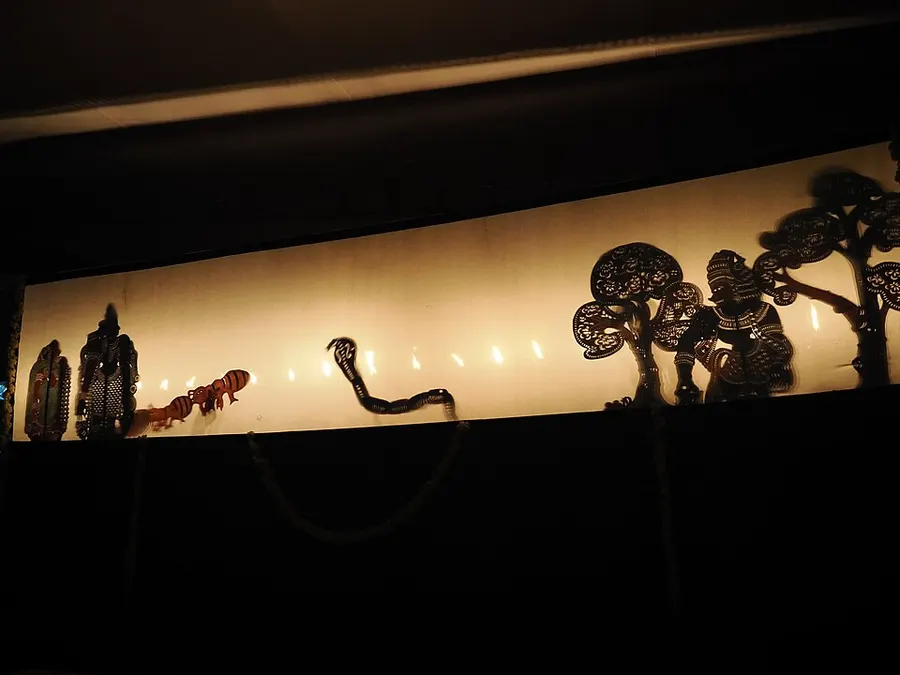
Shadow puppets are masterpieces of craft. They are carved from donkey or cow leather, repeatedly scraped until translucent, then dyed with brilliant colors and cut into intricate patterns. Each puppet consists of 10-15 jointed parts controlled by rods. A single puppet may take months to complete.
03
Regional Traditions
China has dozens of distinct shadow puppetry traditions. Luanzhou puppets are known for their fine carving and facial painting inspired by Peking Opera. Shaanxi puppets are larger and more robust. Sichuan puppets are smaller and more delicate. Each tradition preserves local dialects, music, and storytelling styles.
04
One Puppeteer, a Whole Troupe of Voices
Performance practice concentrates astonishing range in few hands. A rural troupe typically fields five members, and the lead singer voices every character in the play while manipulating up to four figures at once, switching from general to heroine to demon between breaths. The repertory leans on military romances drawn from dynastic fiction, with plays such as the Investiture of the Gods cycle running three consecutive nights. Drum, gong, and a two-string fiddle supply the score, and audiences judge the troupe by qia, the stock comic interludes each company guards as trade secrets. The craft behind the figures is documented separately in shadow puppet carving technique, where donkey hide is stretched, scraped to translucency, and joined with thread joints that let a sleeve flick like silk.
05
UNESCO Recognition After Near Collapse
Television emptied village squares in the 1980s, and registered troupes fell from thousands to scattered ensembles by the 1990s. Reversal came through institutional protection. UNESCO inscribed Chinese shadow puppetry on the Representative List in 2011, covering traditions across Shaanxi, Shanxi, Hebei, and Gansu, and national bearers such as Wei Jinchao trained apprentices through subsidized academies in Xi'an and Huaxian. Museums in Paris and Berlin had collected puppets a century earlier, so restorers today work from both living masters and European holdings. Festival circuits now book troupes into school gyms and hotel stages alike, keeping the lamp-lit screen lit for another generation.
06
From Firelight to Projector
Chinese animation was born in shadow puppetry's workshop logic. The Wan brothers, pioneers of Shanghai animation, credited leather-silhouette shows as their formative grammar before producing the country's first talkie cartoon in the 1930s, borrowing the jointed-limb logic shared with paper-cut carving for cel animation. The debt ran both directions: the 1958 short Pig Eats Watermelon used puppet-carving techniques directly on film, and later features hired shadow artisans to choreograph fight sequences frame by frame. Digital stages now continue the exchange, projecting scanned hide figures with motion capture while live musicians keep the percussion cues. Museum workshops report waiting lists as families carve practice skins with blunt tools under resident masters' supervision, feeding the apprentice pipeline that television once drained. The art's economics still rest on festival bookings, but its visual language circulates globally through animation archives, ensuring the silhouette style outlives any single troupe's finances.