menu_book The Full Narrative
01
The Chemistry of Jade-Green
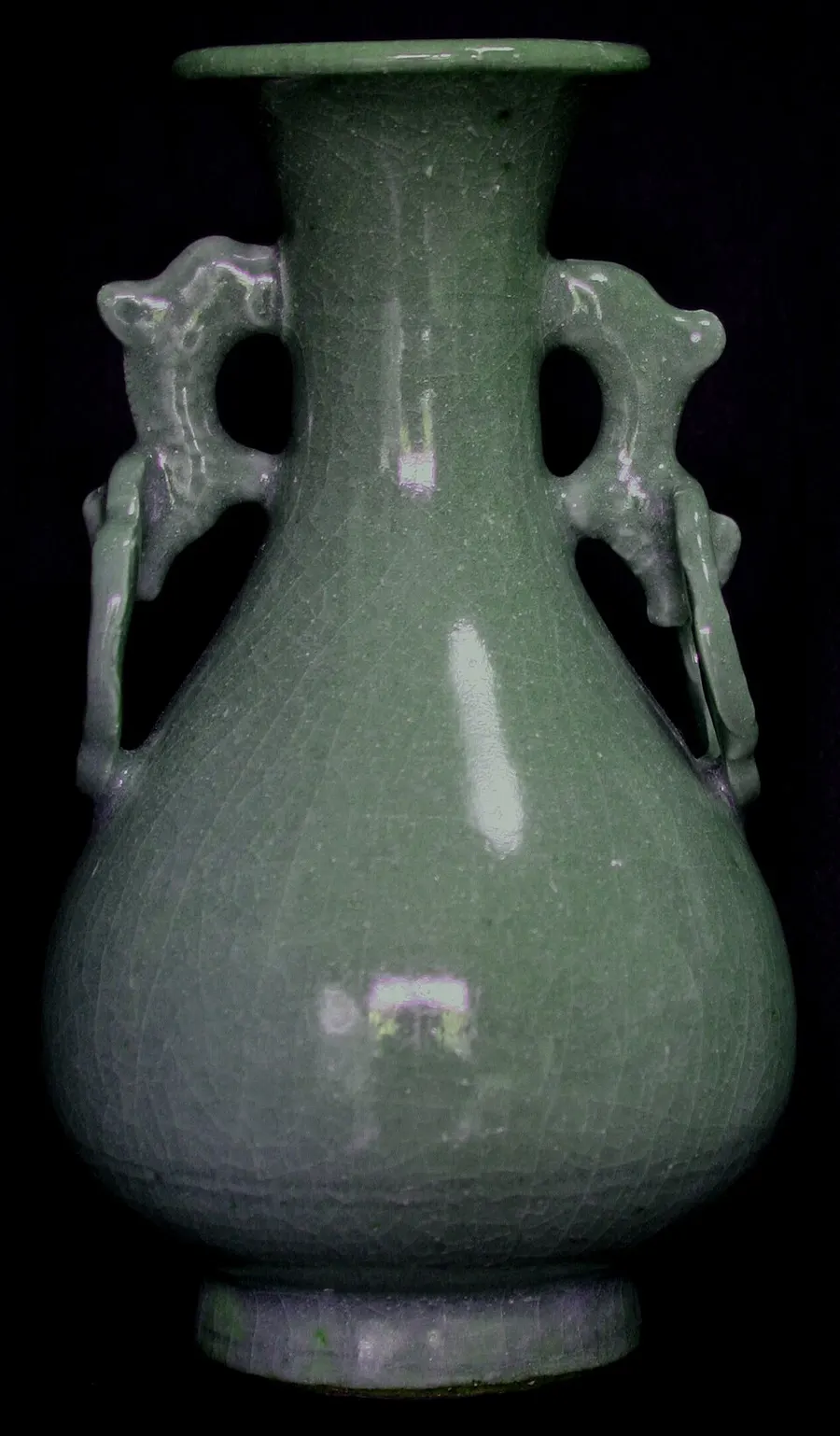
Longquan celadon's iconic jade-green color comes from a delicate chemical dance. Iron oxide in the glaze reacts to a reduction kiln atmosphere (oxygen-starved firing) to produce the celadon color. Too much iron and the glaze turns olive or brown; too little, and it stays clear. Master potters learned to control the kiln atmosphere with remarkable precision.
02
The Song Dynasty Golden Age
Celadon reached its artistic peak during the Song Dynasty, when imperial tastes favored subtlety over ornamentation. Song celadon vessels are celebrated for their simple, elegant forms — a bowl, a vase, a censer — without any decoration beyond the luminous glaze. The beauty was in the color and texture alone.
03
Global Demand
Longquan celadon was exported across Asia, the Middle East, and East Africa. Archaeologists have found Longquan celadon shards in the Great Mosque of Kilwa (Tanzania) and in the palaces of Persian kings. It was the most widely traded Chinese ceramic before blue-and-white porcelain.
04
The Crackled Glaze That Became Canon
The crackle networks prized on antique Longquan ware began as cooling accidents and matured into deliberate technique. Around 1200 two Zhejiang brothers split the market into two styles. Zhang the Elder kept the family glaze smooth and jade-like. Zhang the Younger fired wares whose glaze contracted faster than the clay beneath it, drawing fine webs across every surface. Collectors later labeled the paired traditions the Ge kiln and the Di kiln. Depth of color came from layering three or four separate glaze coats before firing, building coatings close to one millimetre thick. After 1300 the porcelain kilns of Jingdezhen captured world markets with painted wares, and Longquan output narrowed toward high-status crackled vessels.
05
The Kilns Rekindled
Longquan firing survived near extinction during the twentieth century. War and changing taste closed almost every commercial kiln by the 1930s. In 1956 regional authorities rebuilt the celadon workshops under state sponsorship, and veteran potters reconstructed reduction firing from memory and shard evidence. Master Xu Chaoxing recovered Song-era glaze formulas through more than a thousand documented test firings. In 2009 UNESCO inscribed the traditional firing technique of Longquan celadon on the Representative List of the Intangible Cultural Heritage of Humanity. Roughly one hundred studios now operate across the county, and visitors can follow this continuity through the celadon heritage sites of Zhejiang along the upper Ou River.
06
Celadon at the State Banquet
Longquan glaze reentered official ceremony in the twenty-first century. When Hangzhou hosted the G20 summit in 2016, the state dinner service drew on Longquan celadon aesthetics, placing the Song dynasty green before delegations as tableware diplomacy. Provincial kilns had prepared for decades: master potters rebuilt dragon-kiln firing schedules from shard analysis, and design institutes paired their glazes with modern forms for award submissions at home and abroad. Museum acquisitions followed, with major Chinese collections adding contemporary celadon beside antique shards to display continuity rather than rupture. Young graduates of the Longquan ceramic school now split between reproduction commissions and original studio work, and several have shown at international design biennales where the jade-like surface reads as contemporary minimalism. The city's annual porcelain expo reports sales growth led by tea ware, tying today's Hangzhou tea culture back to the glaze's original literati market.