陕西省
Shaanxi Province
An ancient imperial heartland centered on Xi'an, Shaanxi is famous for Qin Opera, the Terracotta Warriors, and the Ansai waist drum dance of the Loess Plateau.
As a vital node in China's cultural geography, this location has nurtured artistic traditions that have endured through dynastic changes, social transformations, and the challenges of modernity. The continuity of these practices speaks to the deep relationship between place and cultural identity.
Today, Shaanxi Province continues to be a living center of heritage — where master artisans train the next generation, festivals mark the seasons, and ancient crafts adapt to contemporary life.
Civilization Snapshot
Where heritage lives — the geography of cultural practice
Interact with the nodes of cultural heritage across the region's ancient grid.
Heritage District
The cultural heart of Shaanxi Province
Craft Village
Traditional workshops and living heritage
The heritage collection of Shaanxi Province
A Lineage of Eras
Keepers of the Flame
Master Artisan
“The craft is not just technique — it is the memory of our ancestors speaking through our hands.”
EXPLORE MASTERSMaster Artisan
“The craft is not just technique — it is the memory of our ancestors speaking through our hands.”
EXPLORE MASTERSThe Cultural Constellation of Shaanxi Province
The heritage of Shaanxi Province does not exist in isolation. It is the core of a sophisticated network of exchange, where techniques, motifs, and melodies traveled to shape the identity of an entire civilization.
- Beijing Connected Heritage
- Nanjing Connected Heritage
- Suzhou Connected Heritage
The Rhythms of Time
Spring Festival
2 seasonal observances
Summer Festival
2 seasonal observances
Autumn Festival
2 seasonal observances
Winter Festival
2 seasonal observances
Nearby heritage destinations
Beijing
北京 · The capital of China, Beijing has been the political and cul...
Nanjing
南京 · An ancient capital of six dynasties, Nanjing is the birthpla...
Suzhou
苏州 · Famous for its classical gardens and silk industry, Suzhou i...
Chenjiagou
陈家沟 · A small village in Henan Province, Chenjiagou is the birthpl...
History & Development
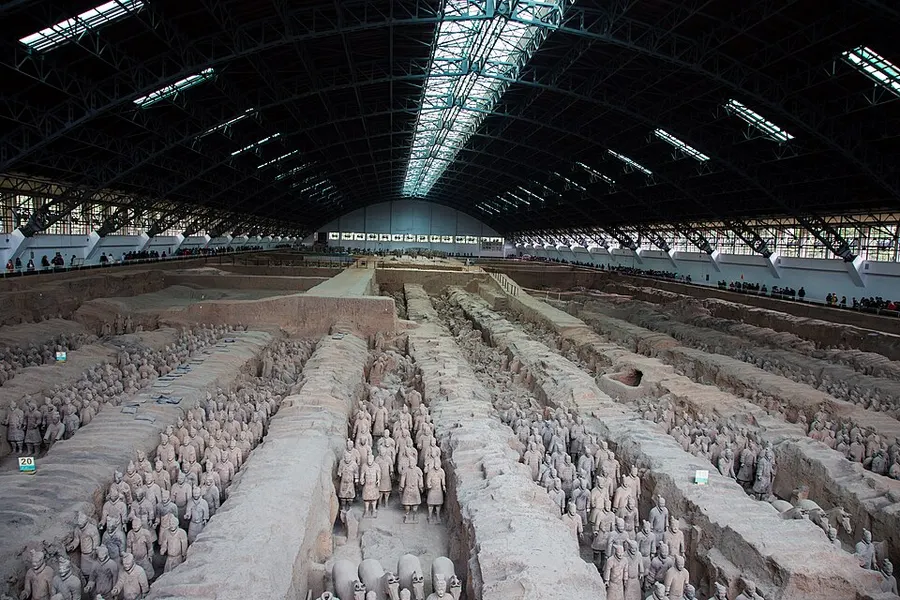
Xi'an served thirteen dynasties across eleven hundred years, longer than any other Chinese capital, and Zhou, Qin, Han, and Tang rulers ringed it with mausoleums. In 1974 well-diggers struck the Terracotta Army: roughly eight thousand life-size soldiers and horses guarding Qin Shi Huang's tomb, inscribed in 1987 among China's first World Heritage entries.
Silk Road departures began here when Zhang Qian rode west around 138 BCE. The city walls rebuilt under the early Ming still enclose fourteen kilometres, while Famen Temple's crypt, opened in 1987, yielded a finger relic of the Buddha with imperial Tang tea vessels that rewrote the history of tea ceremony. Northern loess keeps its own arts: Ansai waist drums thunder and Fengxiang woodblock prints colour doorways each new year.
Cultural Traditions
- 01
Terracotta Rows
Pit one alone marshals six thousand infantry in battle formation under a modern hangar.
- 02
Loess Drums
Ansai waist drummers leap and spin in yellow-dust whirlwinds at festivals.
- 03
Shadow Play Alleys
Huaxian puppeteers flick twenty sticks behind cloth while a single singer voices whole operas.
Common Questions
How many dynasties ruled from Xi'an?
Thirteen across eleven centuries, from Western Zhou through Tang.
When was the Terracotta Army found?
March 1974, by farmers digging a well east of the tomb mound; excavation continues today.
Where did the Silk Road begin?
Chang'an, modern Xi'an, whence Zhang Qian departed about 138 BCE toward Central Asia.