Traditional Dance
Xi'an, Northwest China
Ancient Zhou Dynasty (1046–256 BCE) origins
National Heritage
Master-Apprentice
Oral Tradition
Ansai Waist Drum Dance
"An explosive dance of drumming, leaping, and shouting from the Loess Plateau — the fierce heartbeat of northern Shaanxi."
CIVILIZATION CONTEXT
This artifact is part of the Intangible Heritage Cluster. It connects to 6 entities across the atlas, spanning 1 region, 0 masters, 0 festivals, and 0 skills.
Ansai Waist Drum Dance: A Living Heritage
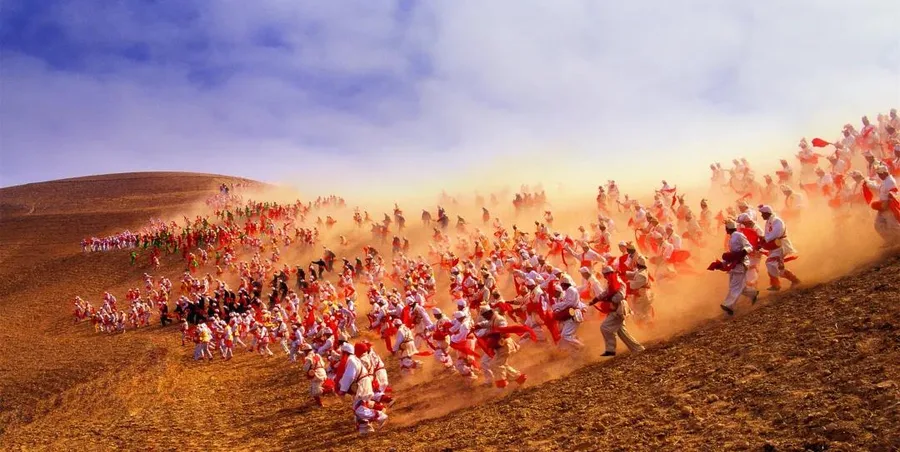
The Ansai waist drum dance is a vigorous folk performance from Ansai County in Shaanxi Province. Dancers tie waist drums diagonally across their bodies and beat them with drumsticks while leaping, spinning, and shouting. The powerful, explosive movements symbolize the spirit of the Loess Plateau. It was originally performed as a sacrificial ritual and war dance, and later evolved into a celebratory folk art performed at festivals and national events.
2282+
Years of Unbroken Lineage
0
Related Cultural Vectors
History & Development
The Ansai waist drum turned a Loess Plateau garrison signal into China's most explosive folk percussion. Ansai county in northern Shaanxi sat on frontier ground where soldiers strapped drums to their waists to relay alarms and celebrate victories; the drum migrated into harvest celebration, and by the late Qing every Ansai village fielded its own drummers. The style is defined by leaps, kicks, and spins struck mid-air, a martial energy that made the form famous nationwide after 1942 new-yangge troupes folded it into mass performance.
Television made it an icon. The 1984 film "Yellow Earth" staged 150 drummers on a frozen hillside, and the 1990s Asian Games and National Day ceremonies fielded Ansai formations in the hundreds, at times a thousand drummers shaking stadium stands. The art entered the first national inventory batch in 2006, and Ansai county now counts drum teams in nearly every village, with schoolchildren learning the "horse-riding" stance before they can read music. Performers still sew their own red leg-wraps, and the yellow earth of the plateau remains the stage floor of choice.
The official state dossier fixes the record: entered in 2006 in the first batch of the national list of intangible heritage, filed under traditional dance with inventory code III-13 (item no. 116), declared by Ansai County, Shaanxi, and safeguarded by the Yan'an Ansai District Cultural Relics Museum, which also serves as the district intangible heritage protection centre. The dossier names three state-recognised transmitters of the drum: Cao Huairong (born December 1939, register no. 02-0360), Liu Yanhe (register no. 05-2220), and Tan Haize, all of them Han drumming masters from Ansai itself.
The application text splits the art into two playing manners and three stage shapes. Wen gu, the "civil drum", leads with the twist — heavy swaying, light striking, close in spirit to yangge stepping; wu gu, the "martial drum", leads with the strike — heavy hitting, light twisting, with big kicks, jumps and turns. Performance takes three forms: lu gu (road drum) danced in procession on the march, changdi gu (ground drum) opened out on a plaza, and wutai gu (stage drum) adapted for the theatre. The lineage runs deep: the Song poet Su Shi wrote of a hundred waist drums rolling like spring thunder over Liangzhou, confirming waist drumming in the northwest frontier garrisons, and the folklore traces the drum to Qin-Han soldiers who carried it, alongside blade and bow, as battlefield equipment — alarm, morale, retreat, victory signal. Modern milestones follow: the top prize at the first national folk music and dance contest in 1986, the Ministry of Culture naming Ansai "Home of the Chinese Waist Drum" in 1996, and a registered trade mark for "Ansai Waist Drum" in 2003.
The year turns on a full ritual cycle. It opens with ye miao, the temple visit, when a drum troupe heads by the umbrella-bearer's lead to the village temple with gongs, suona and sacrificial offerings, drumming in the temple square to delight the gods. In the days after New Year the teams start yan men zi, house-to-house rounds, performing in each courtyard while the umbrella-head improvises auspicious yangge verses tailored to the household — hosts believe the drums and dancing drive off misfortune for the year. A local saying captures the itch of the season: "When the gongs, drums and suona ring away, a rod levers up the bone beneath you" — no one can stay seated. Neighbouring villages then exchange visits in da cai men, "raising the colour gate", a friendly touring of troupes between settlements. On the fifteenth of the first lunar month all the village teams converge on the town square for the great drum contest, the high point of the year; if two teams meet on the road they first trade sung greetings and give way, but when neither yields the meeting turns into a duel of beating until one side's formation breaks or its umbrella-head loses the singing match, and the loser gives way. That night the whole community walks the turning-lantern maze, zhuan jiu qu, nine winding lanes of lamps, drums leading the household processions. The season closes on the seventeenth or eighteenth with thanks to the earth god, and the drummers turn to spring ploughing.
How It Is Made
- 01
Tuning the barrel drum
Calfskin is wetted, stretched, and laced over a poplar barrel; humidity on performance day decides how the rim ropes are tightened.
- 02
Mastering the two mallets
Red silk ribbons tie mallets to wrists; the flat hit speaks, the rim click accents, and combinations are drilled to reflex.
- 03
Drilling the aerial strikes
Signature moves like the horse kick and spinning jump all strike the drum at the apex, so timing and acrobatics fuse into one motion.
- 04
Forming the formations
Squadrons of 30 to 300 weave scissors-and-iron patterns across loess slopes, the leader's umbrella and cymbal pair steering the mass.
Common Questions
How many drummers perform at once?
Village troupes run dozens, while ceremonial events have fielded 1,000 drummers; the Spring Festival story describes how New Year streets fill with these formations.
Why is it called a "waist" drum?
The cylindrical drum ties at the hip with a long red sash, freeing both hands for mallets while the body leaps, unlike the standing storytelling drum played seated.
What should I watch for?
The mid-air strike. Elite drummers hit the drumhead at the top of a spinning jump, and the sound stays perfectly on the collective beat.
What is the difference between the "civil" and "martial" drum?
The official application text divides Ansai waist drumming into wen gu, the civil drum, which leads with twisting and swaying and strikes lightly, and wu gu, the martial drum, which leads with heavy striking and light twisting, with big kicks, leaps and turns. Stage troupes today blend the two into a combined style.
How do the drum teams keep the New Year season?
The season runs on a fixed ritual cycle: a temple visit with offerings and drumming to open the year, house-to-house New Year rounds with improvised blessing songs, exchange visits between neighbouring villages, then a mass drum contest in the town square on the fifteenth of the first lunar month, closing with the lantern-maze walk and thanks to the earth god around the seventeenth.
Watch & Learn
Stories & Legends
Shadow Puppetry: Light, Leather, and Legend
historicalThe world's first animated cinema, centuries before film.
Related Places
Relationship Constellation
Tracing the invisible threads that connect Ansai Waist Drum Dance to the broader civilization ecosystem.
Continue the Journey
Ansai Waist Drum Dance
Traditional Dance
Dragon Lantern Dance
Traditional Dance
arrow_forwardChinese Kung Fu (Wushu)
Traditional Sports
arrow_forwardDizi (Chinese Bamboo Flute)
Traditional Music
arrow_forward