黑龙江省
Heilongjiang Province
China's northeasternmost province, home to the Hezhen people along the Amur River and their endangered Yimakan storytelling tradition.
As a vital node in China's cultural geography, this location has nurtured artistic traditions that have endured through dynastic changes, social transformations, and the challenges of modernity. The continuity of these practices speaks to the deep relationship between place and cultural identity.
Today, Heilongjiang Province continues to be a living center of heritage — where master artisans train the next generation, festivals mark the seasons, and ancient crafts adapt to contemporary life.
Civilization Snapshot
Where heritage lives — the geography of cultural practice
Interact with the nodes of cultural heritage across the region's ancient grid.
Heritage District
The cultural heart of Heilongjiang Province
Craft Village
Traditional workshops and living heritage
The heritage collection of Heilongjiang Province
A Lineage of Eras
Keepers of the Flame
Master Artisan
“The craft is not just technique — it is the memory of our ancestors speaking through our hands.”
EXPLORE MASTERSMaster Artisan
“The craft is not just technique — it is the memory of our ancestors speaking through our hands.”
EXPLORE MASTERSThe Cultural Constellation of Heilongjiang Province
The heritage of Heilongjiang Province does not exist in isolation. It is the core of a sophisticated network of exchange, where techniques, motifs, and melodies traveled to shape the identity of an entire civilization.
- Beijing Connected Heritage
- Nanjing Connected Heritage
- Suzhou Connected Heritage
The Rhythms of Time
Spring Festival
2 seasonal observances
Summer Festival
2 seasonal observances
Autumn Festival
2 seasonal observances
Winter Festival
2 seasonal observances
Nearby heritage destinations
Beijing
北京 · The capital of China, Beijing has been the political and cul...
Nanjing
南京 · An ancient capital of six dynasties, Nanjing is the birthpla...
Suzhou
苏州 · Famous for its classical gardens and silk industry, Suzhou i...
Chenjiagou
陈家沟 · A small village in Henan Province, Chenjiagou is the birthpl...
History & Development
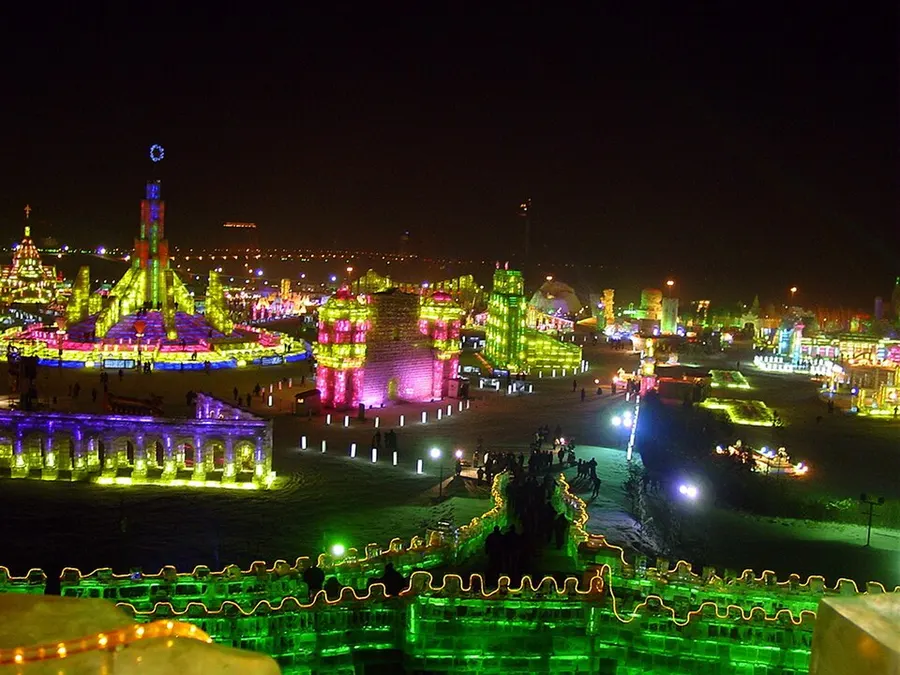
China's northernmost and easternmost province reaches latitudes past 53 degrees north at Mohe, where winter thermometers fall below minus thirty Celsius, and touches dawn first at Fuyang on the Amur. Ice shaped its capital's fame: garden-scale ice lanterns lit Harbin's Zhaolin Park in 1963, growing into the International Ice and Snow Festival whose 1999-era megablocks now draw millions each January.
Harbin itself is a railway child. Russian surveyors drove the Chinese Eastern Railway through marshland from 1897, leaving onion-domed churches and cobblestone Central Street alongside Chinese trading quarters. Upstream, the tiny Hezhen nation, barely five thousand people, kept the Yimakan storytelling epic alive until UNESCO placed it under urgent safeguarding in 2011.
Cultural Traditions
- 01
Ice Architecture
Saw-cut Songhua blocks build castles, slides, and pagodas lit by colour LEDs nightly.
- 02
Salmon-Skin Craft
Hezhen fishers stitch clothing from cured chum salmon leather.
- 03
Border Harvests
State farms reap soy and rice across some of Asia's largest post-glacial plains.
Common Questions
Where can you see China's coldest winter art?
Harbin's Ice and Snow World, descended from 1963 lantern displays, opens late December.
Who tells the Yimakan epic?
Hezhen narrators in northeast river towns; UNESCO listed it as needing urgent protection in 2011.
Why does Harbin look Russian?
Engineers and merchants of the Chinese Eastern Railway built its cathedrals and arcades after 1898.