河南省
Henan Province
The cradle of Chinese civilization on the Central Plains, Henan is the birthplace of Shaolin Kung Fu, Henan Opera (Yuju), and numerous ancient cultural traditions.
As a vital node in China's cultural geography, this location has nurtured artistic traditions that have endured through dynastic changes, social transformations, and the challenges of modernity. The continuity of these practices speaks to the deep relationship between place and cultural identity.
Today, Henan Province continues to be a living center of heritage — where master artisans train the next generation, festivals mark the seasons, and ancient crafts adapt to contemporary life.
Civilization Snapshot
Where heritage lives — the geography of cultural practice
Interact with the nodes of cultural heritage across the region's ancient grid.
Heritage District
The cultural heart of Henan Province
Craft Village
Traditional workshops and living heritage
The heritage collection of Henan Province
A Lineage of Eras
Keepers of the Flame
Chang Xiangyu
“The craft is not just technique — it is the memory of our ancestors speaking through our hands.”
READ THEIR STORYThe Cultural Constellation of Henan Province
The heritage of Henan Province does not exist in isolation. It is the core of a sophisticated network of exchange, where techniques, motifs, and melodies traveled to shape the identity of an entire civilization.
- Beijing Connected Heritage
- Nanjing Connected Heritage
- Suzhou Connected Heritage
The Rhythms of Time
Spring Festival
2 seasonal observances
Summer Festival
2 seasonal observances
Autumn Festival
2 seasonal observances
Winter Festival
2 seasonal observances
Nearby heritage destinations
Beijing
北京 · The capital of China, Beijing has been the political and cul...
Nanjing
南京 · An ancient capital of six dynasties, Nanjing is the birthpla...
Suzhou
苏州 · Famous for its classical gardens and silk industry, Suzhou i...
Chenjiagou
陈家沟 · A small village in Henan Province, Chenjiagou is the birthpl...
History & Development
Henan is China's archaeological heartland: four of the country's eight ancient capitals lie here, and Anyang's Yinxu site surrendered oracle bones first deciphered in 1899, inscriptions proving the Shang dynasty to sceptical modern science. The Simuwu ding, at 832 kilograms the heaviest ancient bronze ever cast, emerged nearby.
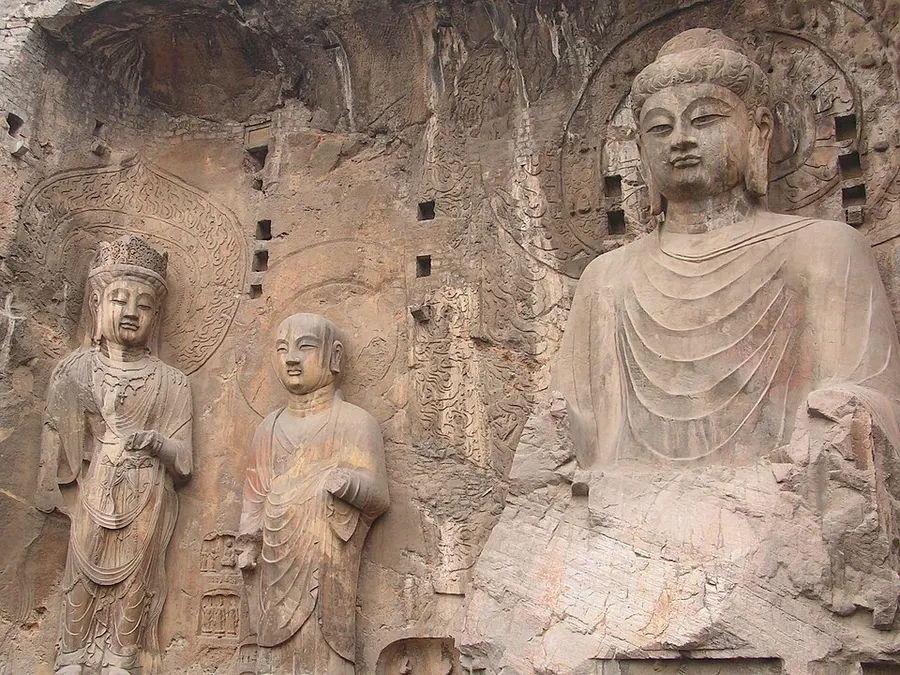
Sacred art and living stages continue the story. Luoyang's Longmen Grottoes, begun in 493, carve one hundred thousand Buddhist figures including the serene seventeen-metre Vairocana, World Heritage since 2000. Meanwhile Henan opera commands China's largest regional audience, and Chenjiagou village formalised tai chi, now practised by hundreds of millions worldwide after its 2020 inscription.
Cultural Traditions
- 01
Oracle Divination
Royal scribes heated turtle plastrons, read cracks, and archived questions of war and harvest.
- 02
Grotto Devotion
Donors funded niches in Dengfeng's sacred county and Longmen cliffs for a thousand years.
- 03
Henan Stage Fire
Rustic, trumpet-led Yu opera draws bigger crowds than any other local genre.
Common Questions
Why is Henan called the cradle of Chinese civilisation?
Shang capitals, the Yellow River's loess farms, and earliest writing all cluster on its plains.
What was found at Yinxu?
Fifteen thousand inscribed oracle bones so far, royal archives of divination from 1250 BCE.
Where does tai chi come from?
Chenjiagou village on the Yellow River flats, where Chen Wangting systematised the art in the seventeenth century.