menu_book The Full Narrative
01
The Girl of Meizhou Island
Lin Moniang refused marriage and devoted herself to the sea — learning to read the weather, the currents, and the moods of the ocean. In an island community where every family depended on fishing, her gifts made her indispensable. Her compassion was local before it became divine.
02
The Goddess of the Sea
The imperial court canonized Mazu in the Song Dynasty, and her cult spread with Chinese maritime trade. By the Ming Dynasty, Zheng He's treasure fleets sailed under her protection, and her temples multiplied along the coast — from Meizhou to Quanzhou, from Fujian to Hainan, and across the seas to Taiwan, Southeast Asia, and the world.
03
A Birthday That Moves a People
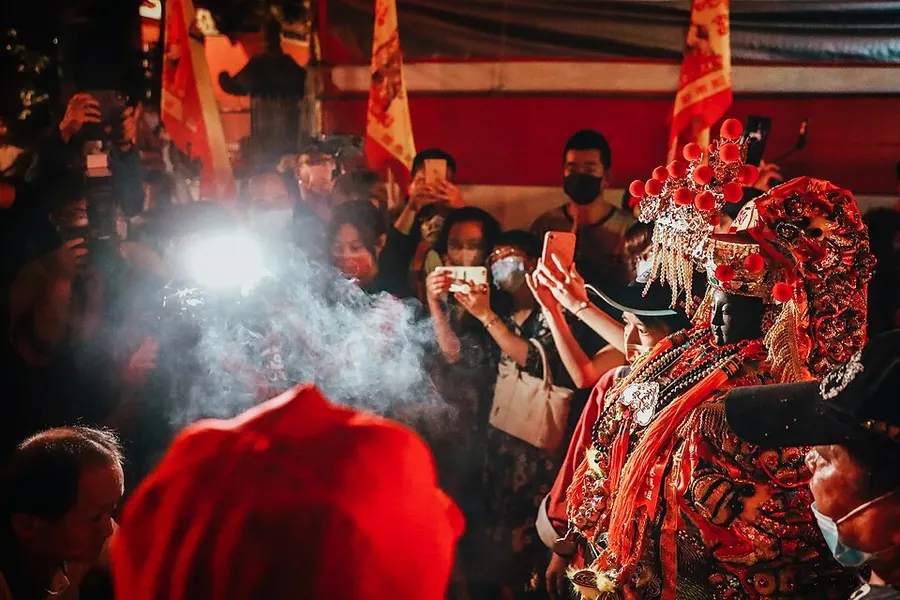
Mazu's birthday, on the 23rd day of the third lunar month, draws millions of pilgrims to Meizhou Island every year. Processions, incense, and ritual opera mark the day; in coastal cities worldwide, temples reenact her birth with a devotion that has never faded. The girl who watched the sea now watches over those who sail it.
04
Titles Bestowed by Successive Emperors
Imperial chanceries promoted Mazu through more than twenty escalating titles across six centuries. Song courts named her a Lady in 1156 and a Princess soon after, Yuan rulers elevated her to Heavenly Consort in 1281 as grain fleets sailed north, and the Qing raised her to Empress of Heaven in 1684 after the Taiwan campaign. Admiral Zheng He credited his seven voyages between 1405 and 1433 to her protection and set up stone tablets saying so. The stele tradition survives in Zheng He's treasure fleet inscriptions that visitors still read today.
05
A Goddess Who Followed the Diaspora
Mazu worship now counts roughly ten thousand temples in more than forty countries and several hundred million devotees. Fujian merchants carried her incense aboard every trading junk, and port communities raised shrine halls wherever junks docked, including the merchant quarters of Quanzhou's medieval harbor. Taiwan alone holds hundreds of active Mazu temples, and its nine-day pilgrimage between Taichung temples moves hundreds of thousands of walkers each spring. UNESCO inscribed Mazu belief and customs on the Representative List in 2009.
06
The Goddess in Print and Chart
Mazu's cult built a documentary record as extensive as any folk religion in China. The Tianfei Xiansheng lu, first compiled in 1687, collected miracle tales and imperial patents into a canonical source that later temple chronicles copied for centuries. Ming and Qing sea charts marked Tianfei palaces alongside depth soundings, making devotion part of navigational infrastructure; pilots trusted a coastline annotated with shrines because it implied safe anchorage and repair crews. Local gazetteers recorded temple repairs in their public works sections, so historians can reconstruct the goddess's economy from tax rolls. Overseas congregations carried printing blocks as ballast, and temples from Penang to San Francisco issued their own gazetteer editions through the nineteenth century. Modern scholars count hundreds of distinct textual lineages, a paper trail that let UNESCO reviewers verify continuous practice across a millennium when Mazu festival traditions were inscribed.