Curated Journey
Chinese Tea: A Reading Route
From leaf to cup
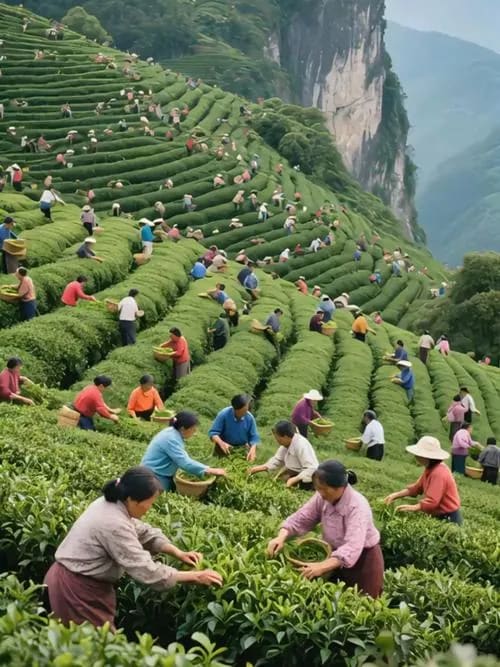
Chinese tea is not just a drink but a cultural chain that runs from picking and making to preparation, social practice, and named places. This route reads six stops in that order: the craft that turns leaf into tea, the practice that turns tea into an occasion, three places that shape, age, and name the leaf, and the boundary where the chain hands off to a different route. The order is the argument — each link turns a plant into a cultural form.
The Route
Chinese tea is not just a drink but a cultural chain that runs from picking and making to preparation, social practice, and named places. This route reads six stops in that order: the craft that turns leaf into tea, the practice that turns tea into an occasion, three places that shape, age, and name the leaf, and the boundary where the chain hands off to a different route. The order is the argument — each link turns a plant into a cultural form.
Stops on the route
The Route in Brief
First, where the plant becomes tea. Tea begins as a leaf, but it becomes tea only when handling is codified. Picking, withering, fixing, rolling, oxidizing, drying, and in some cases aging are decisions that turn a perishable plant into a made object that can be kept. The craft is not one formula; it is a set of choices about how much the leaf changes before it reaches the cup. A common modern classification sorts the result into six categories — green, white, yellow, oolong, black, and dark — by processing rather than by the plant alone. The categories are a teaching tool, not an ancient law, and they show how a single species can be made into several cultural objects. UNESCO has recognized traditional tea processing techniques and associated social practices in China as intangible cultural heritage, framing the skill as a living tradition. This is the first cultural form because the craft can be taught, judged, and inherited. The craft layer is documented in traditional tea processing, where the leaf's handling becomes a teachable skill.
Second, how tea becomes a practice. Once the leaf is made, the next question is how it becomes an occasion. Tea art turns preparation and serving into a practice with vessels, gestures, attention, and a host-guest relationship. The point is not a fixed method but a shared standard: what counts as care, what counts as skill, and how a gathering is organized around the cup. Different regions and settings keep different manners, so the practice is a family of habits rather than one script. A scholar's studio, a family table, and a public gathering can all carry the practice, but they do not carry the same expectations. This is why the practice layer is social rather than technical: it teaches people how to be together around a made leaf. This follows the craft because a made object needs a way to be handled. The practice layer is set out in the Chinese tea ceremony, which treats preparation as a learned social art. Here the cup becomes a social form rather than a private drink, and the skill moves from the maker to the host.
Third, a place that shapes the leaf. Place enters the chain because the same craft does not produce the same leaf everywhere. Fujian is associated with oolong and with rock tea from the Wuyi area, where cultivar, elevation, and rocky ground are read as part of the leaf's identity. The drinker is not only tasting a process but a place's claim about what the leaf can become. This is terroir as a local vocabulary: a way of speaking about soil, cliff, and season that turns agriculture into identity. The claim is not that the ground alone makes the tea, but that the place gives the maker and the drinker a shared language for judging the result. Oolong here is a range of making choices, not a single taste. This follows the practice because a named tea needs a setting to be understood. For the place layer, see Fujian's tea hills, where cultivar and rocky ground shape the made leaf. The cultural form here is a place that shapes the leaf before it is ever named.
Fourth, a place that ages the leaf. Yunnan adds a different claim: time. Pu'er is associated with aging, and old tea trees are part of the region's identity, so the leaf is valued not only for how it is made but for what it becomes over years. This is a cultural form of storage and memory, where a tea can carry a date, a place, and a history of keeping. Aging changes the object's social life. A young tea and an aged tea are not the same cultural thing, even when they come from the same place, because keeping is itself a skill and a claim. The tree matters too: old trees are treated as a living archive of the region's tea history, not just as a source of leaf. This follows Fujian because place can mean either the ground that shapes the leaf or the time that changes it. The aging layer is tied to Yunnan's ancient tea trees, where leaf, tree, and time shape a named tea. The cup here is not just a drink but a record of keeping.
Fifth, a place that names the cup. Hangzhou shows how a place can name the cup. Longjing is tied to the hills around West Lake, and the place name becomes part of the tea's identity, so naming the tea is also naming a landscape. The cultural form here is a named origin: a leaf that carries a place's reputation and a set of expectations about shape, aroma, and season. A named origin is a social agreement. It tells the drinker what to expect and the maker what to protect, and it turns a local practice into a shared reference. The name is a way of saying that this cup belongs to this place. This follows Yunnan because a named tea can be aged in one place and named in another. The naming layer is visible in Hangzhou and Longjing, where a place name becomes part of the cup. The chain closes at the point where a drink becomes a local signature.
Finally, where this route stops. This route stops at the cup and the place. Its subject is the chain that turns a leaf into a made object, a shared practice, and a named local identity. Keeping that boundary is part of the reading order: it tells the reader which questions belong to this chain and which belong to another, so the page does not drift into a different kind of history. The caravan trade that moved tea to the plateau belongs to another route, and the tea horse road story carries that line, while this page stays with leaf, practice, and place. The boundary is not a gap in the story; it is the point where a cultural chain hands off to a trade history.
Highlights
Why this order
Making comes first because without codified handling there is no tea to drink. Practice comes second because a made leaf needs a social way to be prepared and shared. Place comes third because the same craft and practice produce different identities in Fujian, Yunnan, and Hangzhou: one place shapes the leaf, another ages it, and a third names it. The boundary comes last because a cultural chain has to know where it stops. Read in this order, tea is not just a drink but a sequence of transformations: plant into craft, craft into occasion, occasion into local name. The cup is the end of the chain, not the beginning.
One leaf, several cultural forms
A modern classification groups the result into six categories by processing rather than by plant — a teaching tool, not an ancient law. What matters here is not the taxonomy but the idea behind it: one species, handled differently, becomes several made objects. UNESCO recognizes the processing knowledge and associated social practices as a living heritage, which is why the craft is a carrier rather than a footnote.
Where the chain stops
This route ends at the cup and the named place. The caravan trade that carried tea to the plateau belongs to a different line, and the boundary is deliberate rather than a gap. Knowing where a chain stops is part of reading it: it keeps the leaf-to-cup story separate from the trade history that moved the leaf across mountains.
Common Questions
What turns a tea leaf into a cultural form?
Processing turns leaf into a made object, practice turns making into a shared skill, and place turns the cup into a named local identity.
How was tea prepared in ancient China?
Early records describe preparation changing over time — from cooked leaf to powdered tea and later loose leaf — so the method itself is part of the history, not a fixed recipe.
Why are there six tea categories?
A common modern classification groups tea by processing into six categories, but the categories are a teaching tool rather than an ancient or universal division.
How is this route different from the Tea Horse Road?
This route follows leaf to cup through making, practice, and place, while the caravan trade that moved tea to the plateau belongs to a different route.
Why do places matter if the craft is the same?
Because the same processing can produce different identities when cultivar, ground, aging, and naming change what the leaf is understood to be.
From page to place
You followed the route on the page. Now walk it.
This route connects Chinese Tea across a real geography. The visit page turns the same sequence into places you can actually go — city by city, stop by stop.
- 3 national 5A scenic areas (West Lake, Qiandao Lake, Xixi Wetland)
- 16 five-star hotels in the national hotel register
- 6 national rural tourism key villages
This is a reading link, not a booking. Opening hours, tickets and prices change — check current details with the provider on the visit page.
Continue Exploring
Jiangnan: A Reading Route
One body of water, seven carriers
6 stopsThe Silk Road: A Reading Route
From imperial capital to living oasis tradition
6 stopsThe Tea Horse Road
Pressed tea up the mountains, warhorses back down
6 stopsChinese Martial Arts: A Reading Route
Four settings, one reading order
8 stopsOpera Across China
Eight stages, one shared grammar
8 stopsFestivals of the Lunar Year
Eight celebrations, one lunisolar clock
6 stopsChinese Medicine: A Reading Route
From diagrams to daily practice
6 stopsChinese Crafts: A Reading Route
Who kept six crafts alive
8 stopsChinese Music: A Reading Route
From written tablature to the living voice
7 stopsChinese Dance: A Reading Route
From the field's beat to one body on a stage
7 stopsThe Four Treasures: A Reading Route
Brush, ink, paper, stone — and what came next
5 stopsAncient Chinese Cities: A Reading Route
Five stops, one moving center
6 stopsChinese Myths: A Reading Route
From spoken tale to printed image