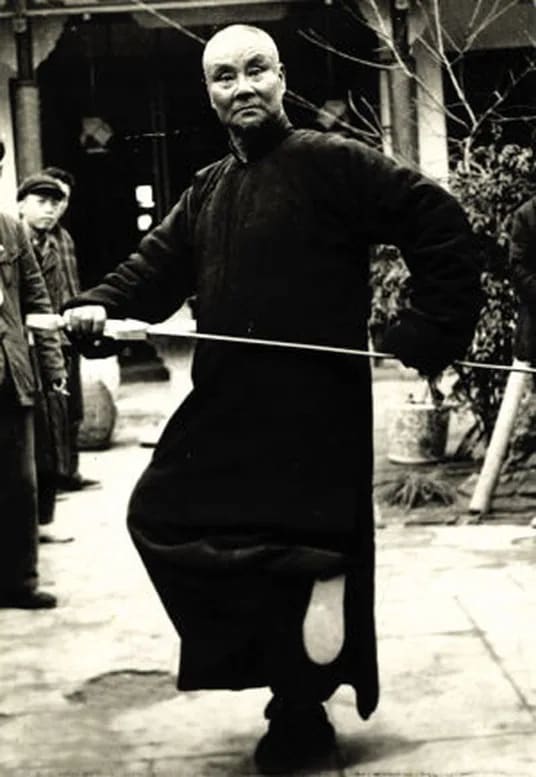
Gai Jiaotian
盖叫天
Gai Jiaotian (1888-1971) was a Chinese Peking Opera wusheng, or martial male performer, known as the "living Wu Song of the south". He founded the Gai school, bringing martial arts and sculptural posing into short-combat roles.
Gai Jiaotian (1888-1971), born Zhang Yingjie, was a Chinese Peking Opera wusheng (martial male) performer and founder of the Gai school. Known as the "living Wu Song of the south", he fused martial arts and sculpture into short-combat stage roles and settled in Hangzhou in his later years.
Heritage DNA
Classification
Master of the Craft
Status
deceased
Year of Birth
1888
Location
Hangzhou
Region
East China
Next Master
Cao Yu
曹禺
See the Craft in Motion
The Cultural Network
Heritage is not a static artifact; it is a living web. These connections trace how a practice travels between people, places and crafts, and how Gai's work sits within a wider tradition.
Domains of Mastery
Territories of Heritage
Geography shapes identity. Journey through the historical corridors that defined a civilization, from the arid Silk Road to the lush Tea Horse Road.
Hangzhou
East China
Masters of the Tradition
The true archive of heritage is found in the hands and minds of those who refuse to let the fire die out.
History & Development
Gai Jiaotian was born in 1888 in Gaoyang county, Hebei, and named Zhang Yingjie. He entered a martial-arts opera training school in Tianjin at eight and first performed under the name "Little Golden Bean". He went to Shanghai around 1900, initially studying older-male roles before returning to wusheng work, and took the name Gai Jiaotian. He trained in the southern wusheng tradition of Li Chunlai while drawing on both Peking and Kun opera.
He became famous for short-combat roles, above all Wu Song, the outlaw of the Water Margin. Contemporaries said he built his fighting from real martial arts and studied sculptures and statues for the shape of a pose, so that stillness on stage carried as much meaning as movement. Chen Yi reportedly called him "a true man of the north, the living Wu Song of the south". He created and revised many plays and designed new weapons and stage effects.
After 1949 he took part in benefit performances and was honoured with a Ministry of Culture award in 1952 and a sixtieth-anniversary celebration of his stage career in 1956. He died in Hangzhou in 1971. The broader art form is described on our Peking Opera page.
Gai Jiaotian at a Glance
Core facts from People's Daily, the Gaoyang county government and CCTV records.
| Detail | Record |
|---|---|
| Born - died | 1888 - 1971 |
| Real name | Zhang Yingjie (张英杰), style name Yan-nan |
| Origins | Gaoyang county, Hebei; settled in Hangzhou in later life |
| Field | Peking Opera - wusheng (martial male), short-combat (duanda) roles |
| School | Founder of the Gai school (盖派) |
| Stage names | Began as "Little Golden Bean"; later Gai Jiaotian |
| Signature roles | Wu Song, The Crossroads, Fighting for the Pass |
| Recognition | Ministry of Culture award, 1952; 60-year stage anniversary, 1956 |
Cultural Traditions
-
Martial Arts on Stage
Gai grounded his combat in real martial skill rather than pure stage convention. He believed a fight should read as a plausible contest between two people.
-
The Sculptural Pose
He studied statuary to shape the body in stillness. A held pose, he argued, should reveal the character's spirit, not just display gymnastic ability.
-
Short-Combat Specialism
The duanda repertoire stresses close-quarter fighting and everyday costume over the armour and acrobatics of long-combat wusheng. Gai made it a distinct artistic language.
-
Wu Song as Signature
His cycle of Wu Song plays became the measure of the Gai school. The "tiger-fighting" scene in particular was associated with his name.
Common Questions
Who was Gai Jiaotian?
Gai Jiaotian (1888-1971) was a Chinese Peking Opera wusheng performer born in Hebei, known as the "living Wu Song of the south" and founder of the Gai school of short-combat performance.
Why was he called the living Wu Song?
He was celebrated for his cycle of plays about Wu Song, the Water Margin outlaw. His realistic fighting and powerful stage presence made the role inseparable from his name.
What is the Gai school known for?
It emphasises short-combat roles built on martial arts and expressive, sculpture-like poses. Gai studied statues to shape a held pose and wanted stillness to convey character.
Where did Gai Jiaotian live later in life?
He spent much of his career in Shanghai and settled in Hangzhou in his later years. He died there in 1971 and his tomb is in Hangzhou.
Where can I read about Peking Opera?
The history and performance conventions of the art form are covered on our Peking Opera page.
Behind the name
A life in craft leads somewhere you can visit.
The visit layer traces the traditions behind these profiles to the places where the craft is still taught and practised today.
This is a reading link, not a booking. Opening hours, tickets and prices change — check current details with the provider on the visit page.
The Atlas is Living
Every master is a living archive. Join a collective of explorers, artisans, and scholars dedicated to tracing the vibrant pulse of our shared world.