Traditional Dance
Foshan, South China
Three Kingdoms period (220–280 CE)
National Heritage
Master-Apprentice
Oral Tradition
Lion Dance
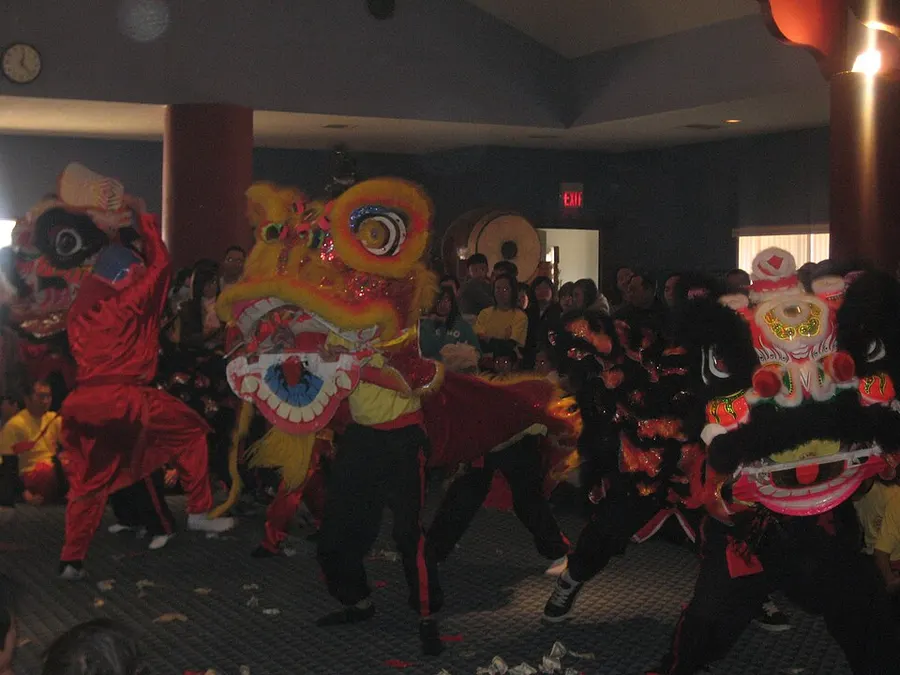
"An acrobatic dance performance where two dancers become a lion, bringing good luck and warding off evil during celebrations."
CIVILIZATION CONTEXT
This artifact is part of the Intangible Heritage Cluster. It connects to 6 entities across the atlas, spanning 2 regions, 0 masters, 0 festivals, and 0 skills.
Lion Dance: A Living Heritage
The Lion Dance is a traditional Chinese performance where two dancers operate a lion costume — one controlling the head, the other the body. Mimicking a lion's movements with acrobatic stunts, the dance is believed to bring good luck and ward off evil spirits. Two main styles exist: Northern Lion Dance (playful, pekingese-like) and Southern Lion Dance (powerful, kung-fu inspired).
1746+
Years of Unbroken Lineage
0
Related Cultural Vectors
History & Development
Lion dance fused Han exorcism rites with a lion China never had, creating a guardian animal assembled from temple sculpture and battlefield footwork. Tang court records list the "Great Peace Music" lion performed by five coloured lions, and Ming-era militia in Foshan drilled lion movements inside martial-arts halls, which is why every step still maps onto a horse stance. Northern schools kept the shaggy, dog-like comic lion of court entertainment, while southern schools forged the fierce, wide-eyed futsan head with a movable mouth and a horn for butting.
The plum-blossom poles turned celebration into sport. From the 1980s Malaysian and Chinese troupes raised their stages onto staggered steel posts up to three metres tall, and the 1990s saw the first world championships under the International Dragon and Lion Dance Federation, with Malaysia and mainland crews alternating titles since. Judging now splits difficulty from artistry, rewarding jumps between poles a full body length apart. Guangdong's awakening lion entered the national inventory in 2006, and the form crossed oceans so thoroughly that Chinatowns from San Francisco to Kuala Lumpur book lion troupes year-round.
How It Is Made
- 01
Framing the head
A rattan or bamboo basket armature is bound into brow, horn, and hinged jaw, then papier-mâché layers set the fierce southern profile.
- 02
Fur and bristle work
Northern lions wear long white shearling piles; southern lions get combed bristle brows and a mirror on the forehead to scatter evil.
- 03
Painting the character
Liu Bei, Guan Gong, and Zhang Fei face patterns encode temperament through colour, black-bearded generals dancing slower and heavier.
- 04
Training the stances
Two-person teams drill horse and cat stances for months before touching poles, because every jump is launched from kung-fu footwork.
Common Questions
Why do lions eat greens?
"Plucking the green" pays the troupe: lettuce hung with a red packet is chewed and scattered for luck, a custom documented in our lion dance story.
How tall are the poles?
Competition plum-blossom posts run 1.2 to 3 metres with gaps up to 1.8 metres; a slip means a fall onto mats, so crews train with spotters for years.
Is the same lion used at funerals?
No; white lions accompany mourning processions in some southern lineages, but festive red, gold, and green heads are reserved for celebrations like the ones listed under Lantern Festival.
Watch & Learn
Stories & Legends
The Dancing Lion: From Exorcism to Celebration
historicalWhen two people become one beast, evil spirits flee and prosperity arrives.
Related Places
Relationship Constellation
Tracing the invisible threads that connect Lion Dance to the broader civilization ecosystem.
Continue the Journey
Lion Dance
Traditional Dance
Yangge Dance
Traditional Dance
arrow_forwardChinese Paper-Cut
Traditional Crafts
arrow_forwardDragon Dance
Traditional Dance
arrow_forward