menu_book The Full Narrative
01
The Nian Connection
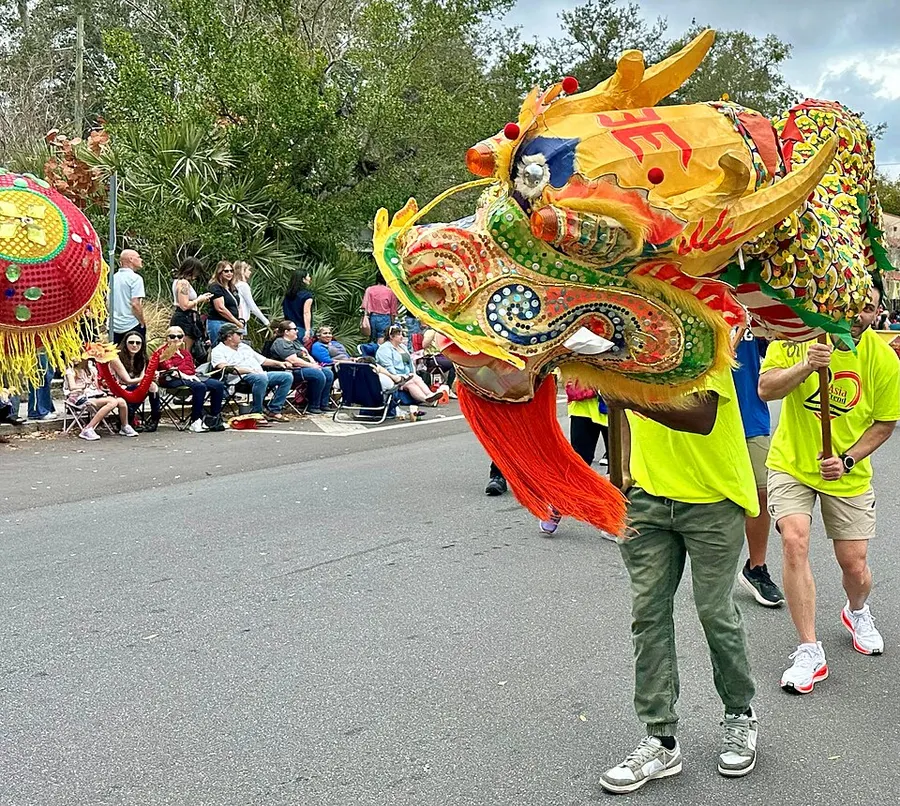
Like Spring Festival itself, lion dancing may have originated as protection against Nian, the mythical monster. The lion was believed to have the power to ward off evil spirits. The dance became an essential part of festivals, especially Spring Festival, weddings, and business openings — chasing away bad luck and inviting prosperity.
02
Northern and Southern Styles
Two distinct lion dance traditions developed. The Northern lion resembles a Pekinese dog with a golden mane and performs acrobatic feats on tables and balls. The Southern lion (associated with Guangdong) has a larger head with a mirror on its forehead and performs the distinctive "three-star" beat of the drum, cymbal, and gong.
03
From Ritual to Sport
Lion dance competitions are now held worldwide, judged on technical difficulty, synchronization, and artistic expression. The most challenging moves involve jumping onto high poles or "plucking the green" — snatching a lettuce and red envelope from a high point. What began as an exorcism ritual has become a competitive sport and a symbol of Chinese identity.
04
Plucking the Green Pays the Troupe
The plucking-the-green custom also finances the art. Shopkeepers hang lettuce above their doors with a red envelope, and the lion "eats" it before scattering leaves for luck. During Spring Festival a busy Foshan lion dance workshop troupe can perform at dozens of storefronts in a single day, and those fees buy drums, silk fur, and travel. Diaspora communities from San Francisco to Kuala Lumpur sustain year-round bookings for the same ritual.
05
Plum-Blossom Poles Raise the Stakes
Competition codified the spectacle into measurable skill. Teams now leap across stacked plum-blossom poles rising roughly three meters, where one missed paw means a fall, and judges score difficulty, synchronization, and expression point by point. Since the first world championships in the 1990s Malaysian and Chinese teams have traded titles, while wushu acrobatic conditioning entered troupe training. Guangdong awakening-lion practice joined China's national heritage list in 2006.
06
One Beast, Two Grammar Books
Northern and Southern lion dance operate on two distinct movement grammars that trainers describe as separate disciplines. The northern style, descended from court entertainment recorded in Tang sources, emphasizes realism: performers mimic pouncing, shaking, and rolling with shaggy golden costumes, often pairing lions with comedic keepers. The southern style codes every gesture as martial technique; a plum-blossom jump is a stance drill, and the eyelid flutter signals readiness to strike. Guangdong troupes classify routines by difficulty syllabus the way gymnastics does, and black-belt equivalents exist as graded certificates issued by provincial associations. The two grammars rarely mix in competition, but cinema fused them: Wong Fei-hung films staged northern-style spectacle with southern-style footwork, creating the hybrid audiences expect on screen. Students who want stage careers train both books, while temple troupes guard whichever local grammar their lineage preserves, maintaining footwork that overlaps with wushu conditioning. The split is living evidence that one mythic animal can carry two fully developed performance systems.