Quyi
Beijing, North China
Ming Dynasty (1368–1644 CE)
National Heritage
Master-Apprentice (Oral/Aural)
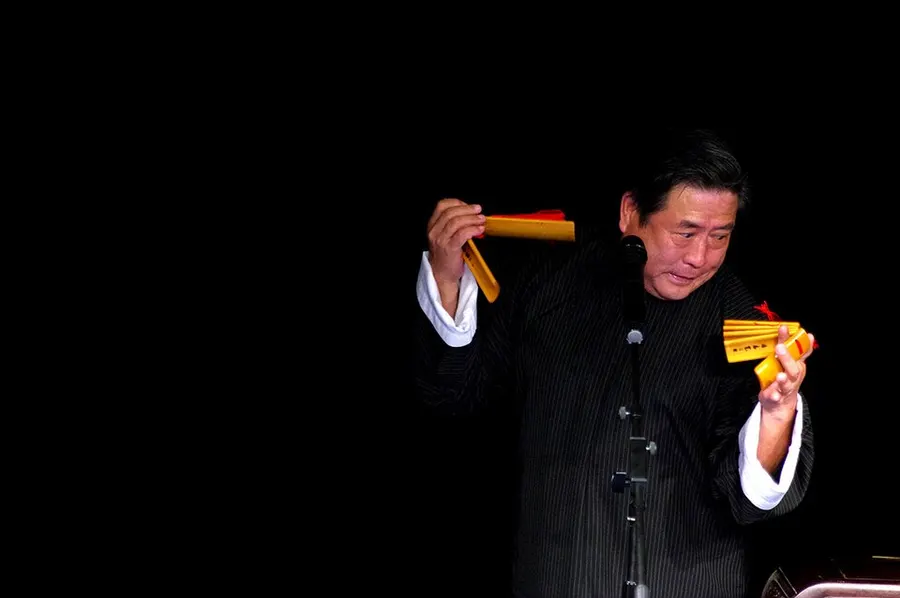
Kuaiban (Clapper) Performance
Kuaiban (Clapper Talk)
"A rapid-fire oral art of rhyming verse accompanied by bamboo clappers — Beijing's temple fair tradition of linguistic virtuosity."
CIVILIZATION CONTEXT
This artifact is part of the Intangible Heritage Cluster. It connects to 8 entities across the atlas, spanning 2 regions, 1 master, 0 festivals, and 1 skill.
Kuaiban (Clapper Talk): A Living Heritage
Kuaiban is a rapid-paced Chinese oral performance art where the performer narrates stories while rhythmically clicking bamboo or brass clappers. Accompanied only by the percussive clapper rhythm, the performer recites verses in a fast, rhythmic patter, changing pace and tone to portray different characters and emotions. Originating as a folk art in Beijing's temple fairs, Kuaiban remains popular for its sharp social satire, humor, and the extraordinary tongue-twisting speed of its masters.
382+
Years of Unbroken Lineage
1
Related Cultural Vectors
History & Development
Kuaiban pairs rapid-fire rhymed monologue with bamboo castanets the performer plays themselves, turning street-corner patter into tight musical comedy. Roots reach to Qing-era beggar verse and market hawking cries, and northern cities adopted it as a fast opener before slower stage acts.
The form split into solo kuai ban shu storytelling and group rhymed dialogue, both built on strict rhyme families that let performers improvise topical verses overnight. Schools teach counting syllables per clap, and television galas keep the clatter recognisable to every Chinese audience.
How Clappers Drive the Rhyme
- 01
Holding the boards
One big板 and small tiles click in layered patterns, so beginners drill hand independence before speaking a word.
- 02
Riding the rhyme scheme
Lines end in shared rhyme families, and performers memorise word banks per rhyme to swap verses for new occasions.
- 03
Punching the rhythm
Syllables land exactly between clicks; rushing or dragging breaks the illusion that speech itself is percussion.
- 04
Closing with a twist
Pieces end on a punchline or moral snap timed to a final triple click, the form s signature button.
Common Questions
Is kuaiban comedy only?
Mostly comic today, but propaganda eras used it for news, and traditional pieces include heroic storytelling beside joke routines heard around Beijing stages.
Can it be improvised?
Skilled artists compose fresh verses on sight for weddings or openings, relying on the rhyme banks drilled in training similar to crosstalk improvisation.
What equipment is needed?
Just two hands of bamboo tiles, which is why street origins persisted and classroom teaching spreads cheaply nationwide.
Watch & Learn
Stories & Legends
How Cloisonné Entered the Imperial Court
historicalThe art of trapping color in metal, from Byzantium to Beijing.
Skills & Techniques
Kuaiban (Clapper) Performance expand_more
The rapid-fire art of rhyming verse accompanied by bamboo or brass clappers, requiring extraordinary tongue speed and rhythmic precision.
Steps
- Hold the bamboo clappers (kuaiban) correctly — three large and two small
- Practice basic clapper rhythms: single-click, roll, and stop patterns
- Memorize rhyming verses and practice recitation at increasing speed
- Coordinate clapper rhythm with vocal delivery — matching accents and pauses
- Add theatrical elements: voice character changes, comedic timing, audience interaction
Tools
bamboo clappers (kuaiban), brass clappers, small table, fan
Materials
bamboo strips, brass sheets, cotton cord
Related Places
Generations Preserved
Li Zhi
Li Zhi is a master of Kuaiban (clapper talk) from Beijing, renowned for his extraordinary tongue speed and satirical wit. A protégé of the Kuaiban tradition, he has performed at major national galas a...
Relationship Constellation
Tracing the invisible threads that connect Kuaiban (Clapper Talk) to the broader civilization ecosystem.
Continue the Journey
Kuaiban (Clapper Talk)
Quyi
Tanci (Ballad Singing)
Quyi
arrow_forwardPingshu (Storytelling)
Quyi
arrow_forwardQin Opera (Qinqiang)
Traditional Drama
arrow_forward