Traditional Crafts
Anhui Province, East China
Tang Dynasty (618–907 CE)
Representative List
Master-Apprentice (Hands-on)
Xuan Paper Making
Xuan Paper Making
"The world's finest calligraphy paper, made by hand through 108 steps over three years — "paper that lasts a thousand years.""
CIVILIZATION CONTEXT
This artifact is part of the Intangible Heritage Cluster. It connects to 10 entities across the atlas, spanning 1 region, 0 masters, 0 festivals, and 1 skill.
Xuan Paper Making: A Living Heritage
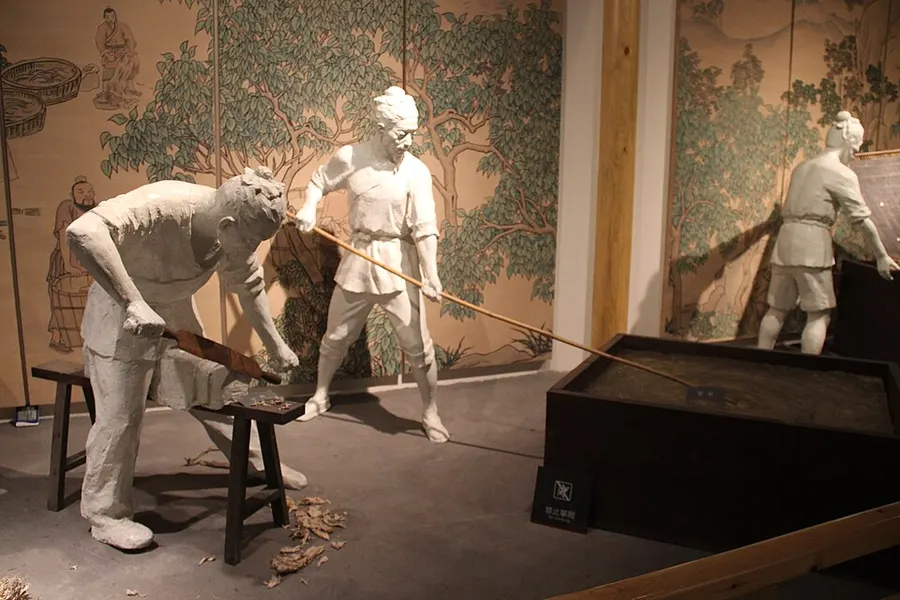
Xuan paper, produced in Jing County, Anhui Province, is considered the finest paper for Chinese calligraphy and painting. Made from the bark of the blue sandalwood tree (Pteroceltis tatarinowii) mixed with rice straw, it undergoes 108 steps over three years. The paper is prized for its absorbency, durability ("paper that lasts a thousand years"), and ability to show the subtle gradations of ink wash.
1119+
Years of Unbroken Lineage
1
Related Cultural Vectors
History & Development
Xuan paper, made in Jing County of Anhui, is the substrate Chinese painting and calligraphy trusted for a thousand years. Tang tribute records list the paper by its prefecture name, and Song collectors already prized its ink-revealing surface, which holds a brushstroke's every speed change while resisting age, insects, and light. The secret is fibre blending: blue sandalwood bark gives length and strength, rice straw gives absorbency, and proportions shift across dozens of grades from thin cicada-wing sheets to heavy board-like stock.
Making it is an industrial-scale ritual of patience. A finished sheet passes through more than one hundred processes, and bark bundles cure through three winters of hillside bleaching before pulping even begins, which is why masters describe xuan as "paper that drinks three years of weather." UNESCO inscribed the craft in 2009, citing both its technical chain and its role in conserving art itself, since restorers mount damaged scrolls on new xuan; today two county factories supply most of the world, their vats still dipped by hand pairs trained for years.
How It Is Made
- 01
Curing the bark
Sandalwood bark is steamed, stripped, and spread on granite slopes through repeated freezes and sun until naturally white.
- 02
Blending the pulp
Bark and straw fibres are beaten into slurry and mixed by grade recipes guarded within each workshop.
- 03
Lifting the sheet
Two workers dip a bamboo screen and rock it in rhythm; a second's tilt changes thickness across the whole sheet.
- 04
Drying on fire walls
Wet sheets are brushed onto heated walls and peeled at exact humidity, giving xuan its flat, dimensionally stable finish.
Common Questions
Why is it called thousand-year paper?
Surviving Song sheets remain flexible because alkaline processing preserves fibre length; conservators rely on that chemistry when mounting ancient works described in our printing story.
What is it made from?
Blue sandalwood bark for strength and rice straw for absorbency, blended in ratios that define each of the many grades sold around Jing County.
Why do painters prefer it?
Its sized-but-porous surface records every brush nuance, the quality that makes calligraphy training inseparable from good paper.
Watch & Learn
Stories & Legends
Woodblock Printing: The First Information Revolution
historicalHow carved pear wood changed the world, 600 years before Gutenberg.
Skills & Techniques
Xuan Paper Making expand_more
The complex craft of producing xuan paper from blue sandalwood bark and rice straw through a 108-step process taking over three years.
Steps
- Strip bark from the blue sandalwood tree and sun-dry
- Soak and steam the bark to soften fibers
- Beat the bark into a fibrous pulp with lime
- Mix with rice straw pulp in precise proportions
- Scoop the pulp onto a bamboo screen to form sheets
- Press and dry sheets on heated walls
- Inspect, trim, and bundle finished paper
Tools
bamboo screen mold, pulp vat, pressing stone, heated drying wall, knife, bamboo pole
Materials
blue sandalwood bark (Pteroceltis tatarinowii), rice straw, lime, water
Related Places
Relationship Constellation
Tracing the invisible threads that connect Xuan Paper Making to the broader civilization ecosystem.
Continue the Journey
Xuan Paper Making
Traditional Crafts
Yueju Opera (Cantonese Opera)
Traditional Drama
arrow_forwardEngraved Block Printing
Traditional Crafts
arrow_forwardRegong Arts
Traditional Crafts
arrow_forward