Traditional Crafts
Qinghai Province, Northwest China
Yuan Dynasty (1271–1368 CE)
Representative List
Master-Apprentice (Hands-on)
Thangka Painting
Regong Arts
"A vibrant school of Tibetan Buddhist art from Qinghai — thangka painting, murals, sculpture, and applique in brilliant mineral colors."
CIVILIZATION CONTEXT
This artifact is part of the Intangible Heritage Cluster. It connects to 12 entities across the atlas, spanning 1 region, 1 master, 0 festivals, and 1 skill.
Regong Arts: A Living Heritage
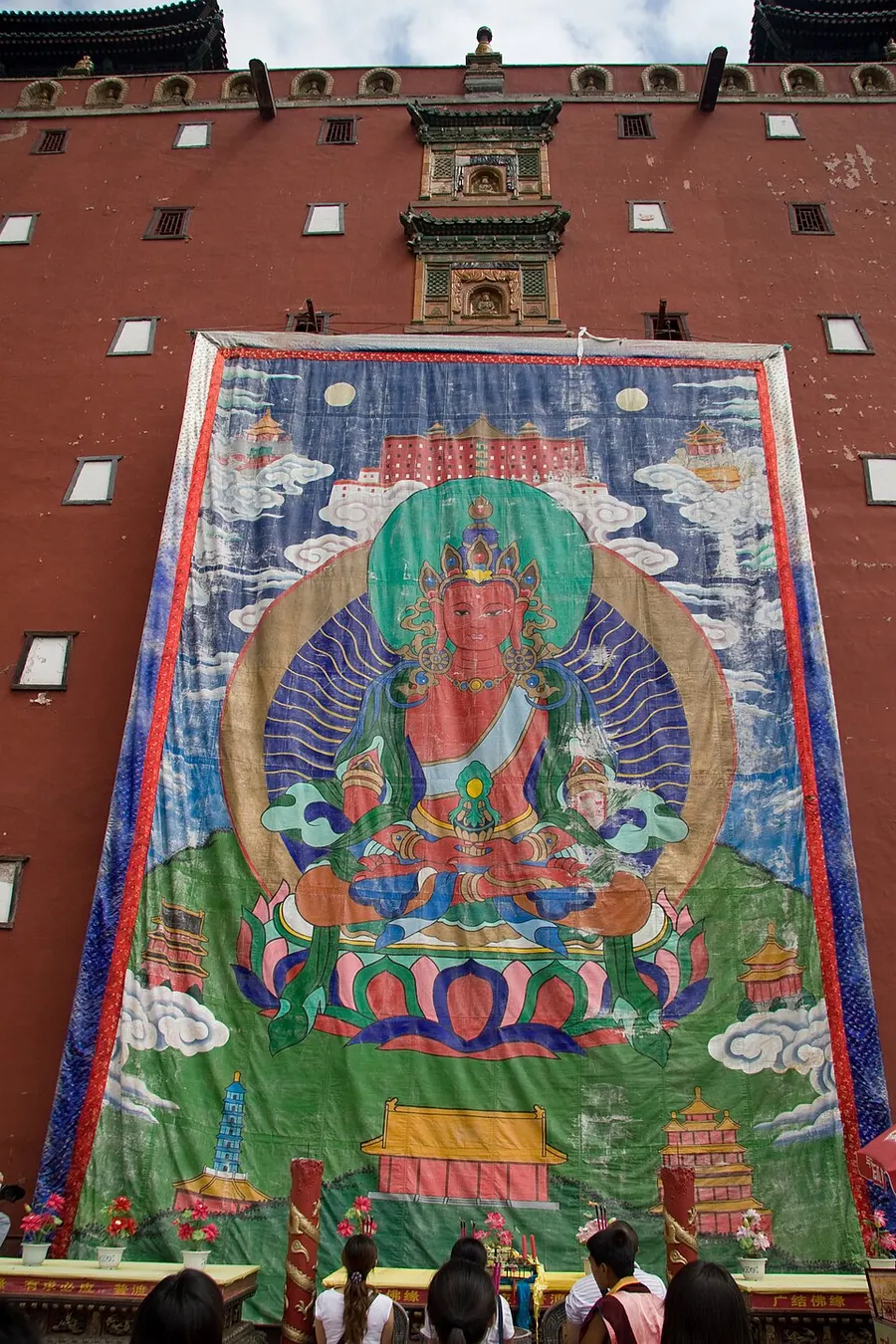
Regong arts are a distinctive school of Tibetan Buddhist visual arts originating from the Regong (Tongren) area of Qinghai Province. The tradition encompasses thangka painting, mural art, clay sculpture, and applique. Characterized by brilliant mineral pigments, precise iconography, and intricate gold detailing, Regong art has been preserved by local monastic and lay artists for over 700 years. Each thangka can take months to complete.
658+
Years of Unbroken Lineage
1
Related Cultural Vectors
History & Development
Regong arts are Tibetan Buddhist sacred painting and sculpture from Rebgong, the Amdo valley now called Tongren in Qinghai. Monastery ateliers there developed a distinctive thangka style with dense landscape backgrounds, jewel-toned mineral pigments, and precise iconometric grids, alongside clay sculpture and embroidered tangka appliqué, the barbdola. Workshops fed the region's great monasteries from at least the seventeenth century, and families passed brush lineages down generations alongside monastic training.
The 2009 UNESCO inscription put Rebgong on the world map, crediting both painting and the appliqué tradition. Masters grind malachite, lapis, and cinnabar into pigments that outlast oils by centuries, and a large museum-grade thangka still consumes months of grid-checked brushwork. Contemporary Rebgong studios supply monasteries and collectors worldwide, and local schools teach boys iconometry before perspective, keeping the sacred geometry primary; our thangka entry details the painting sequence itself.
How It Is Made
- 01
Preparing the canvas
Cotton is stretched, sized with hide glue and chalk, then burnished with conch until the surface takes pigment like ivory.
- 02
Gridding the deity
Iconometric proportions are ruled in red lines; deviation from canonical measure voids a religious image.
- 03
Painting in layers
Backgrounds go first, then figures, then gold line work; mineral pigments are applied in washes and burnished between passes.
- 04
Opening the eyes
Final pupils are painted in an auspicious-hour rite that consecrates the image for devotion.
Common Questions
What makes Regong style distinct?
Dense green landscapes behind central deities and jewel saturation from local mineral pigment, a contrast with central Tibetan schools visible across our thangka overview.
Are all Regong arts paintings?
No; the listing covers sculpture and the barbdola appliqué hangings of cut silk, alongside the painted scrolls.
Can tourists visit studios?
Yes; Tongren's Longwu monastery quarter hosts family ateliers where visitors watch grinding and gridding, and festival seasons reveal processional appliqué pieces.
Watch & Learn
Stories & Legends
Tibetan Opera: Masks of the Himalayas
historicalAt 4,000 meters, a masked opera has been performed for over 600 years.
Skills & Techniques
Thangka Painting expand_more
The sacred Tibetan Buddhist art of painting deities and mandalas on cotton or silk using mineral pigments and following strict iconographic proportions.
Steps
- Prepare the canvas by stretching cotton fabric on a frame
- Apply a gesso of animal glue and chalk, then polish smooth
- Draw the iconographic grid following precise scriptural proportions
- Paint the background with ground mineral pigments mixed with glue
- Apply gold and silver details for highlights
- Outline figures and features with fine brush strokes
- Mount the finished thangka on silk brocade
Tools
stretching frame, fine brushes (various sizes), palette, gold stylus, measuring cords
Materials
cotton fabric, silk brocade, mineral pigments (lapis lazuli, malachite, cinnabar), 24k gold, animal glue
Related Places
Generations Preserved
Jin Xiuping
Jin Xiuping is a master thangka painter from the Regong (Tongren) region of Qinghai Province. Learning from her father at age 12, she spent over 40 years mastering the strict iconographic rules of Tib...
Relationship Constellation
Tracing the invisible threads that connect Regong Arts to the broader civilization ecosystem.