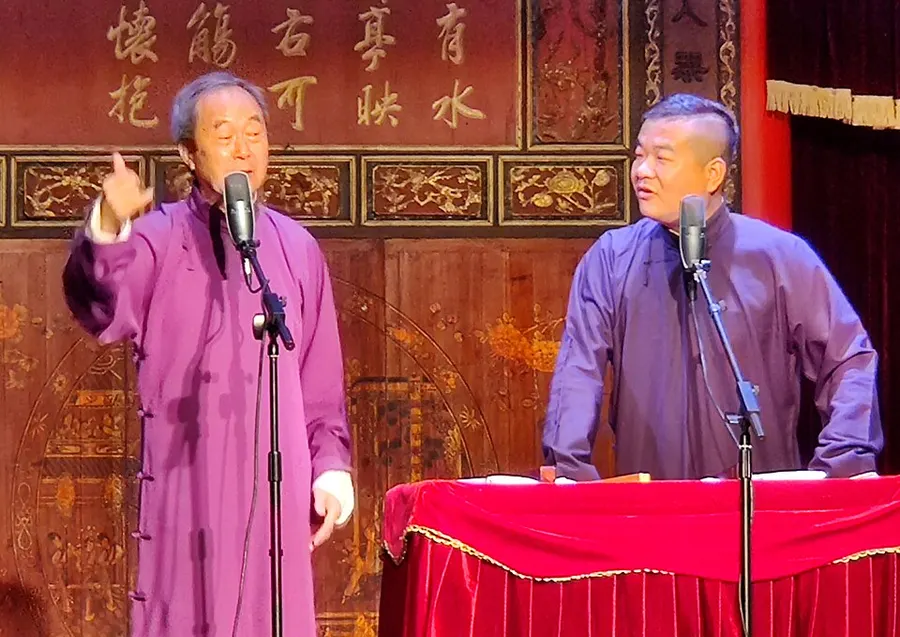
Quyi
Beijing, North China
Qing Dynasty, late 19th century CE
National Heritage
Master-Apprentice (Oral/Aural)
Oral Tradition
Cross-Talk (Xiangsheng)
"China's beloved comedic dialogue tradition — rapid-fire wit, wordplay, mimicry, and social commentary between two performers."
CIVILIZATION CONTEXT
This artifact is part of the Intangible Heritage Cluster. It connects to 7 entities across the atlas, spanning 1 region, 1 master, 0 festivals, and 0 skills.
Cross-Talk (Xiangsheng): A Living Heritage
Cross-talk (xiangsheng) is a traditional Chinese comedic performance typically featuring two performers engaging in rapid-fire witty dialogue. Originating in Beijing's temple fairs, it evolved into one of China's most popular entertainment forms. Performances include storytelling, mimicry, singing, and wordplay. Famous masters like Hou Baolin transformed it into a vehicle for social commentary and linguistic artistry.
Centuries
Years of Unbroken Lineage
0
Related Cultural Vectors
History & Development
Xiangsheng, crosstalk comedy, builds laughs from two or three performers trading setup and punchline over street-stall roots in late-Qing Beijing and Tianjin. The canon demands four skills, speaking, imitating, teasing, and singing, and classics like Reporting Dish Names turn tongue-twisters into standing ovations.
Radio and television made household names of masters such as Hou Baolin, whose solo narrative pieces are preserved as teaching standards. The State Council listed xiangsheng in the national batch in June 2008, and Deyunshe teahouses now pack young urban audiences who quote routines like pop lyrics.
How It Is Made
- 01
Drilling tongue-twisters
Students recite escalating word-chains daily until syllables stay crisp at comic speed, the foundation of every routine.
- 02
Mastering imitation
Performers mimic opera singers, vendors, and regional accents, sharpening ears before voices.
- 03
Building straight-man chemistry
The gen role feeds deadpan setups while the dou partner detonates them, partnerships rehearsed like dance pairs.
- 04
Closing with sung setpieces
Parodied opera arias and drum songs end many routines, proving the singing skill behind the jokes.
Common Questions
Is it improvised?
Core scripts are memorised, but performers weave in audience-specific riffs, which is why seeing the same piece twice still surprises.
Who defines the classical style?
Masters like Hou Baolin set diction and pacing standards still taught in broadcast conservatories and Beijing teahouses.
Can non-Chinese speakers enjoy it?
Physical bits and rhythm travel farthest; subtitled galas help, but the wordplay rewards learners of the language most.
Watch & Learn
Stories & Legends
The Art of Silence: Peking Opera's Journey from Court to World
historicalIn a Peking Opera performance, every gesture tells a story.
Related Places
Generations Preserved
Hou Baolin
Hou Baolin was the most influential cross-talk (xiangsheng) master of the 20th century, elevating the folk comedic form to a respected performing art. Renowned for his sharp wit, linguistic precision,...
Relationship Constellation
Tracing the invisible threads that connect Cross-Talk (Xiangsheng) to the broader civilization ecosystem.
Continue the Journey
Cross-Talk (Xiangsheng)
Quyi
Sichuan Qingyin
Quyi
arrow_forwardDragon Boat Racing
Traditional Sports
arrow_forwardSuzhou Pingtan
Quyi
arrow_forward