Traditional Crafts
Beijing, North China
Ming Dynasty, Jingtai period (1450–1457 CE)
National Heritage
Master-Apprentice (Hands-on)
Cloisonné Enameling
Cloisonné Enamel
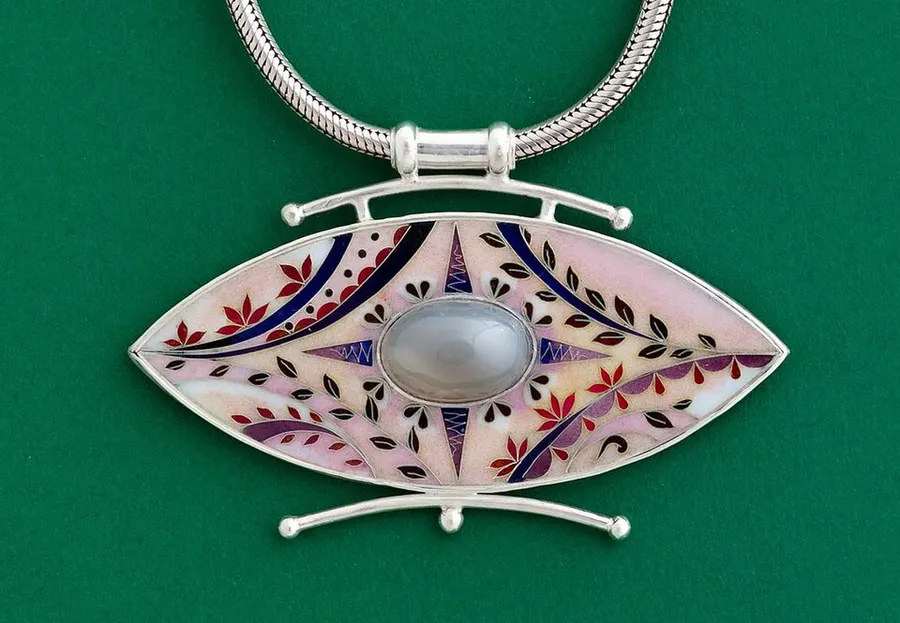
"A brilliant enameling technique from the Ming Dynasty, creating intricate patterns with metal wires and colored glass paste."
CIVILIZATION CONTEXT
This artifact is part of the Intangible Heritage Cluster. It connects to 8 entities across the atlas, spanning 1 region, 0 masters, 0 festivals, and 1 skill.
Cloisonné Enamel: A Living Heritage
Cloisonné (jingtailan) is a decorative metalwork technique where thin metal wires are soldered onto a metal object to form cells (cloisons), which are then filled with colored enamel paste and fired. Originating in the Ming Dynasty's Jingtai period (1450–1457), the craft is known for its brilliant blue hues, intricate patterns, and labor-intensive process involving dozens of steps.
569+
Years of Unbroken Lineage
1
Related Cultural Vectors
History & Development
Cloisonné enamel reached Beijing from the Islamic world and became the most imperial of crafts. Copper bodies are cloisonned with wire cells, filled with coloured enamel paste, fired, ground, and polished; the Yuan era saw the first major Chinese workshops, and the Jingtai reign (1450-1457) produced the deep blue ware so prized that Chinese dealers later called the whole craft "Jingtai blue." Palace inventories list altarpieces, incense burners, and vases by the hundred, their wire outlines holding colours no glaze could match.
The twentieth century industrialised and globalised it. Late-Qing workshops such as Laotianli took the palace craft commercial, winning top prizes at the 1904 St Louis and 1915 Panama-Pacific expositions, and mid-century Beijing factories employed thousands firing enamels for export. Cloisonné headed the first national inventory batch in 2006, and our imperial cloisonné story traces that arc; today fewer than a score of masters still hand-form the wire cells, working in studios around Beijing.
How It Is Made
- 01
Hammering the body
Copper sheet is raised and planished into vase forms, then pickled bright before any decoration begins.
- 02
Bending the wire cells
Artisans pinch copper wire into curves that trace the drawing, then glue and fire the lattice onto the body.
- 03
Filling and firing
Enamel pastes are packed cell by cell and fired; colours sink, so filling and firing repeat up to five times.
- 04
Grinding and gilding
The surface is ground flat, polished smooth, and rimmed with gold, exposing crisp wire lines that define the design.
Common Questions
Why "Jingtai blue"?
The Jingtai reign's cobalt wares defined the look, so the market named the whole craft after them; the reign's context is covered in our imperial cloisonné story.
How many firings does one piece need?
Typically three to five rounds of fill-and-fire, plus final grinding, which is why large vessels take months.
Is real cloisonné always copper?
Traditional Beijing work uses copper bodies with gold or brass wire; cheaper "cloisonné" souvenirs swap in tin alloys and printed decals, unlike the wired craft listed in the Yuan era inventories.
Watch & Learn
Stories & Legends
How Cloisonné Entered the Imperial Court
historicalThe art of trapping color in metal, from Byzantium to Beijing.
Skills & Techniques
Cloisonné Enameling expand_more
The process of decorating metal objects with colored glass paste held in place by thin metal wires.
Steps
- Shape the metal base (copper or bronze) by hammering
- Solder thin copper wires onto the surface to form pattern cells
- Fill each cell with colored enamel paste
- Fire in a kiln to fuse the enamel
- Polish the surface to reveal the wire pattern and enamel gloss
- Gild the exposed wire partitions with gold
Tools
soldering iron, fine tweezers, kiln, polishing stone, engraving burin
Materials
copper sheet, copper wire, enamel powder (various colors), gold leaf, borax flux
Related Places
Relationship Constellation
Tracing the invisible threads that connect Cloisonné Enamel to the broader civilization ecosystem.
Continue the Journey
Cloisonné Enamel
Traditional Crafts
Suzhou Embroidery
Traditional Crafts
arrow_forwardChinese Kite Making
Traditional Crafts
arrow_forwardLongquan Celadon
Traditional Crafts
arrow_forward