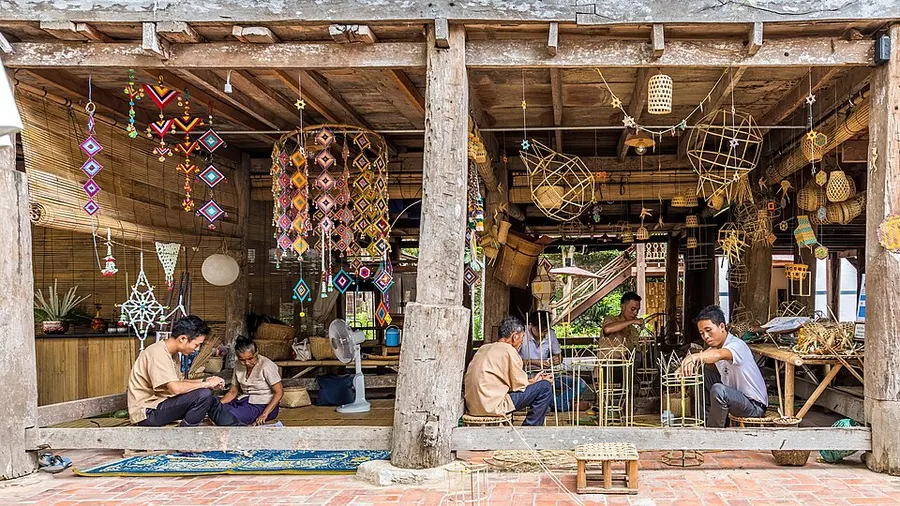
Traditional Crafts
Chengdu, Southwest China
Ancient, predates written records
National Heritage
Master-Apprentice (Hands-on)
Sichuan Bamboo Weaving
Sichuan Bamboo Weaving
"Transforming bamboo into paper-thin strips woven into baskets, screens, and intricate artworks — a harmony of nature and patience."
CIVILIZATION CONTEXT
This artifact is part of the Intangible Heritage Cluster. It connects to 7 entities across the atlas, spanning 1 region, 0 masters, 0 festivals, and 1 skill.
Sichuan Bamboo Weaving: A Living Heritage
Sichuan bamboo weaving is a intricate craft that transforms raw bamboo into fine woven objects — baskets, mats, screens, and even calligraphic artworks. Bamboo strips are split to paper-thin widths and woven using techniques passed down through generations. The craft reflects the Chinese virtues of patience, precision, and harmony with natural materials.
Centuries
Years of Unbroken Lineage
1
Related Cultural Vectors
History & Development
Bamboo weaving turns a grass that grows in months into containers that outlast their makers. Chinese basketry is documented from Warring States tombs, whose woven boxes survive in lacquered splendour, and regional schools specialised by function: Sichuan's porcelain-bodied weaving sheathes ceramics in bamboo skin, Anhui and Hunan wove agricultural and household wares, and Dongyang carved-and-wove architectural fittings. Splitting is the heart of it, since a culm must be divided into strips thin enough to wrap around a teacup without snapping.
The craft modernised along two tracks. Utility baskets faded as plastics spread after the 1960s, pushing masters toward art pieces and the celebrated Qionglai-style porcelain-coated wares that hang in state gifts; meanwhile the national inventory recognised multiple lineages in 2008, including Sichuan bamboo weaving and Dongyang work. Museums now commission weavers to conserve archaeological basketry, and studios near Chengdu teach visitors to weave a strip around porcelain in an afternoon, the same skill masters spend decades refining.
How It Is Made
- 01
Choosing the culm
Three-to-five-year-old bamboo is cut in autumn when starch is low, resisting insect damage for decades.
- 02
Splitting to skin
Layers are cleaved and drawn knife-by-knife until strips reach paper thinness; only the outer skin keeps the jade-green sheen.
- 03
Weaving the matrix
Strips interlace in hexagon, twill, or spiral matrices; porcelain-body weaving starts from a fixed ceramic core so tension must stay perfect.
- 04
Finishing and fitting
Edges are locked with a final locking pass and rims bound in rattan, giving handles and mouths their lasting shape.
Common Questions
What is porcelain-bodied bamboo weaving?
A Sichuan speciality where split bamboo is woven directly around a porcelain blank, hiding the vessel under a textile-like skin; see our porcelain entry for the ceramics side.
How long does a piece take?
Utility baskets take hours, but exhibition vases sheathing entire teapots in millimetre strips run into years.
Does bamboo age well?
Properly cured autumn-cut bamboo darkens gracefully for generations; tomb finds show woven boxes intact after more than two thousand years, much like lacquered lacquerware of the same burials.
Watch & Learn
Stories & Legends
The Porcelain Road: Jingdezhen and the World
historicalA remote town in Jiangxi produced the finest ceramics the world had ever seen for over a thousand years.
Skills & Techniques
Sichuan Bamboo Weaving expand_more
The technique of splitting bamboo into ultra-thin strips and weaving them into functional and decorative objects.
Steps
- Select mature bamboo (preferably 3–4 year old nanmu bamboo)
- Split bamboo lengthwise into strips of uniform width
- Shave strips to paper-thin thickness using a knife
- Dye strips with natural pigments if color is desired
- Weave on a frame using techniques like plain weave, twill, or hexagonal
- Finish edges and apply protective coating
Tools
bamboo knife, strip splitter, shaving plane, scissors, weaving frame, caliper
Materials
bamboo (nanmu variety), natural dyes, tung oil
Related Places
Relationship Constellation
Tracing the invisible threads that connect Sichuan Bamboo Weaving to the broader civilization ecosystem.
Continue the Journey
Sichuan Bamboo Weaving
Traditional Crafts
Chinese Lacquer Art
Traditional Crafts
arrow_forwardChinese Seal Engraving
Traditional Crafts
arrow_forwardChinese Kite Making
Traditional Crafts
arrow_forward